Friday, August 04, 2023

Justice Alito Grants Temporary Stay of Fifth Circuit Decision finding ATF "Final Rule" on Receivers and Frames Illegal


On July 27, 2023, the Attorney General of the Biden Administration, Merrick B. Garland, submitted an application for a stay to Justice Alito at the Supreme Court, in the case of VanDerStok v. Garland. The request for an emergency stay had been refused by a three judge panel of the United States Court of Appeals for the Fifth Circuit on July 24, 2023, as reported on AmmoLand.  One of the possibilities mentioned was the Biden administration would appeal directly to the Supreme Court. The possibility of a request for an en banc decision existed, but was unlikely because the Fifth Circuit has been following the Supreme Court guidance in the Bruen decision for enforcing Second Amendment rights, and because an en banc panel would not have been emplaced for a period of time.

The request for an emergency stay to the Supreme Court is based on the false notions the Final Rule of the ATF on receivers and frames is somehow related to public safety; that "public safety" overrides the Constitution; and that the Executive branch (the Biden Administration) must act because the Legislative branch will not do so.  From page 6:

The district court’s universal vacatur is irreparably harming the public and the government by reopening the floodgates to the tide of untraceable ghost guns flowing into our Nation’s communities.

If this sounds like the familiar song and dance put forward by dictators and authoritarians all over the world, you are correct.

The Final Rule put forward by the ATF reverses over five decades of precedent because the Biden administration wants to do it. Here are some of the arguments put forward in the application filed.  From the request for an emergency stay: Page 3

The Rule does not prohibit the purchase, sale, or possession of any firearm, nor does it prohibit any individual lawfully entitled to possess a firearm from making one at home. Instead, it simply requires compliance with the uncontroversial federal laws “imposing conditions and qualifications on the commercial sale of arms,” District of Columbia v. Heller, 554 U.S. 570, 626-627 (2008).

This is false. The rule prohibits the manufacture of firearms by individuals who are unwilling to submit to the inclusion of their firearms on a federal data system, using tools and parts which have been available for decades. The Gun Control Act has always been controversial. It passed in 1968 because of the unrelenting pressure of President Johnson and the dominant media, leveraging the emotional tumult of the assassinations of Bobby Kennedy and Martin Luther King. It has remained particularly controversial, and has only stayed in effect because the courts have refused to honor rights protected by the Second Amendment. With the publishing of the Supreme Court Bruen decision, restoring Second Amendment protections, numerous provisions of GCA 68 are being challenged in the Courts.  The ban on possession of a firearm where the serial number has been removed is being challenged as well.

page 6:

This Court should stay the district court’s vacatur in full. A stay would prevent further irreparable harm to the public while allowing the litigation in this case and other challenges to the Rule to proceed in the ordinary course. But given the gravity and urgency of the public safety issues at stake, if the Court is not prepared to grant a stay it may wish to construe this application as a petition for a writ of certiorari before judgment, grant the petition, and set this case for argument this fall.

The claim there is irreparable harm to the public is laughable. There are hundreds of millions of firearms already in circulation in the United States. Hundreds of millions of them are already "untraceable". Once a firearm is more than a few years old, "tracing it" is an exercise in futility. Tracing firearms is virtually useless in solving violent crimes. Criminals almost never leave firearms which can be traced to them at the scene of a crime. All that is accomplished by tracing is to waste public resources on the accumulation of useless data. Even full blown registration of firearms almost never is used to actually solve crimes. The idea of "tracing guns" as a useful crime fighting tool is a myth. The serious danger to a viable Second Amendment is the potential of a national gun registry using the requirement for serial numbers imposed by the federal government.

page 18:

An ordinary speaker of English would recognize that a company in the business of selling kits that can be assembled into firearms in minutes -- and that are designed, marketed, and used for that express purpose -- is in the business of selling firearms. A contrary conclusion blinks reality.

No. A kit is not a completed product. When the pieces of a kit must be physically altered to allow the parts to be assembled into a functional firearm, it is not a disassembled firearm. It is a kit, where the purchaser finishes the manufacturing process. Individuals in the United States, who are not manufacturing firearms for commercial sale have always been able to make their own homemade firearms using parts purchased from other parties.

page 20:

The court appeared to accept that “disassembled” weapons are subject to the Act’s requirements, App., infra, 39a, but exempted parts kits that can be assembled into a fully functional weapon in a matter of minutes, see id. at 70a-71a, 81a-88a.

No, this is incorrect. If it takes time and effort to make parts compatible, it takes more time and effort than merely assembling parts. Functional firearms can be made from hardware supplies in "minutes". That does not make pipes into firearms. The pipes are not firearms until the work is done to make them functional.

An unusual part of the brief is the Biden administration attack on "universal relief", where a single district court judge can vacate a law for the entire nation. This tactic has been used, particularly by the Left, for decades. If the court uses this case to eliminate the ability of single district courts to vacate national laws for the entire nation, it will be a victory for limited government. The court could both uphold the ruling, which was upheld by the Fifth Circuit Court of Appeals, and still disapprove of a single district court vacating national law. From Page 29, the Biden Administration attacks "universal relief" :

Universal relief also creates other constitutional, legal, and practical problems. It “strains our separation of powers” by “allowing individual judges to act more like a legislature by decreeing the rights and duties of people nationwide.” Texas, 143 S. Ct. at 1985 (Gorsuch, J., concurring in the judgment). It circumvents the procedural rules governing joinder and class actions. See id. at 1981. It encourages forum shopping by empowering a single district judge to nullify the decisions of other courts upholding the challenged agency action.

The Biden administration makes a laughable claim about reality in 1968. Serial numbers were not required on most firearms (handguns and high-powered rifles were an exception) in 1968. Millions, perhaps tens of millions of firearms without serial numbers were grandfathered into the system in 1968. Homemade firearms, without serial numbers, have been made in the United States from colonial times. From Page 39:

More fundamentally, there was no such thing as a ghost gun in 1968. As recently as 2017, they were a novelty being sold in relatively small numbers. It is only over the last five years that the manufacturing respondents and others have dramatically changed the status quo by selling tens if not hundreds of thousands of firearms outside the Act’s regulations.

This is the progressive argument of that was then, this is now, therefore we must ignore the rules in place and act by diktat!

Predicting what the Supreme Court will do on any issue is difficult. The Court consists of nine people who can see through obvious, inflated rhetoric.  The Supreme Court has already spanked the Biden Administration for attempting to act with dictatorial authority on student loans. The Court has ruled the EPA cannot change law for the entire country by administrative whim.  Refusing to grant the emergency stay to the Biden administration only returns firearms regulation to the status quo before the Biden administration gambit to expand ATF authority was attempted.

The question of whether the entire firearms regulation scheme concocted with the National Firearms Act of 1934, the Federal Firearms Act of 1938, the Gun Control Act of 1968 and the 1986 Gun Owners Protection Act are all an overreach of federal power, not allowed under the Second Amendment, is not addressed.

Update: Justice Alito grants administrative stay for a week. Responses due on August 2, 2023.


©2023 by Dean Weingarten: Permission to share is granted when this notice and link are included.

Gun Watch


TX : Gunfight, Armed Victim Wounded at Taco Stand

SAN ANTONIO - A man who was just waiting to buy breakfast tacos was shot in an exchange of gunfire during an early morning robbery.

The shooting happened around 6:30 a.m. Wednesday in a parking lot near the Tacos De Mama food truck off Blanco Road near Dresden Drive.

Police said two customers were waiting for the truck to open when the armed suspects talked up and demanded their wallets. After they both handed over their wallets, one of the suspects opened fire on the suspects, hitting one in the stomach.

The victim pulled out his gun and returned fire. No word if either of the suspects were hit during the shootout.


More Here

Illinois District Court: Are Suppressors/Silencers Protected by the Second Amendment?


In the United States District Court for the Southern District of Illinois, on November 25, 2022, Larry Morse and Theodore Ray Buck, Jr. filed a lawsuit against the state of Illinois, claiming the state ban on the sale and possession of silencers is a violation of the Second Amendment.  A similar lawsuit was filed by Carlin Anderson and David Clark on February 27, 2023, backed by the American Suppressor Association. The two lawsuits, Morse v Raoul and Anderson v Raoul have been consolidated as of June 15, 2023. The parties involved have agreed the principle area of contention is whether silencers are arms protected by the Second Amendment. Morse and other plaintiffs claim silencers are obviously bearable arms, and are in common use, so they cannot be banned from ownership as they are in Illinois. Here are excerpts from the pleading in Morse v. Raoul. From courlistener.com:

29. As of 20201, there were 2,042,719 suppressors owned by law abiding citizens as registered in the National Firearms Registration and Transfer Record (“NFRTR”), far more than was needed for the DC Circuit to find AR-15s in common use. And that is despite legal impediments to owning a silencer, including the National Firearms Act requirements—paying a $200 transfer tax, submitting a detailed application and fingerprints, and a multi months-long wait for the federal government to process the application. See26 U.S.C. § 5811. Even arms that are far less common have been found to be protected.

Plaintiffs point out that silencers are used for numerous lawful purposes. From the pleading:

33. And the primary purpose of suppressors are for lawful purposes, including hunting, which Heller v. District of Columbia, 399 U.S. App. D.C. 314, 331, 670 F.3d 1244, 1261 (2011) holds is part of the Second Amendment right, self-defense (the core right pursuant to District of Columbia v. Heller, 554 U.S. 570, 628, 128 S. Ct. 2783, 2817 (2008)) and target shooting which both the Seventh and Third Circuits have already found to be protected Second Amendment conduct. The right to self-defense “implies a corresponding right to acquire and maintain proficiency” with common weapons. Ezell v. City of Chicago, 651 F.3d 684, 704 (7th Cir. 2011) [hereinafter Ezell I].

Silencers are in common use. They are used for numerous lawful purposes, including self defense. The major contention of the State of Illinois is silencers are not arms, they are merely an accessory. From the motion by the defendants:

Defendants Kwame Raoul, Brendan F. Kelly, Craig Miller, and Bryan Robbins respectfully move the Court to enter judgment in their favor pursuant to Federal Rule of Civil Procedure 12(c). Plaintiffs raise a Second Amendment challenge to an Illinois law prohibiting the possession of silencers, which are attached to firearms to reduce the noise of gunfire. But the Second Amendment protects only “the right of the people to keep and bear Arms” (emphasis added). Silencers are not weapons. They are not used for self-defense. And they are not necessary to the effective use of a firearm. So they are not “Arms” within the meaning of the constitutional text, and thus plaintiffs cannot prevail on their Second Amendment claim.

Two problems exist with the above claim. The first is silencers are explicitly treated as arms in both Illinois law and federal law. While silencers are not "arms" by themselves, they clearly add to the effectiveness of firearms and serve to aid in the use of firearms for lawful purposes such as self defense. The second is accessories, which make arms more effective, such as aiding in training, are protected under the Second Amendment. The State of Illinois claim could be used to ban magazines (currently under contention) or other firearms accessories such as telescopic sights, red dot sights, flash suppressors, or even such things as rifled barrels or recoil pads. 

The Supreme Court, in Caetano made clear all items which constitute bearable arms fall under the protection of the Second Amendment. Outright bans on bearable arms are not allowed if the arms are in common use for lawful purposes.

This is why the State of Illinois is contending silencers are not arms. If they are not arms, why are they regulated and banned, especially under Illinois and United States weapons statutes? Illinois code 720 ILCS 5/24-1(a)(6) bans the possession of any device or attachment designed, used or intended for use in silencing the report of a firearm. If they are not useful to make firearms more effective, why ban or restrict them? 

If the court rules silencers are arms under the protection of the Second Amendment, the Texas lawsuit against the NFA restrictions on making silencers gains credibility.

Analysis: 

What Illinois is attempting to do is a salami slice destruction of the Second Amendment. Under the theory that accessories, which make weapons more effective, can be banned, the Second Amendment could be reduced to the absurdity of allowing only a single, muzzleloading shotgun for defense in the home. Such an absurd outcome is not allowed under the Second Amendment. 


©2023 by Dean Weingarten: Permission to share is granted when this notice and link are included.

Gun Watch


Thursday, August 03, 2023

ID: Armed Defender Shoots 2 Suspects who Pistol-Whipped Resident

Police determined that Jones’ injuries had been caused by someone entering his home and pistol-whipping him, Char Jackson, Caldwell police spokesperson, told the Idaho Statesman. They also discovered that during the assault, “a person associated with the male victim shot at the suspects as the victim was pistol-whipped repeatedly,” causing the suspects to flee the scene, according to the news release. Caldwell police said they soon learned from Nampa police that two people had admitted themselves to a Nampa hospital with gunshot wounds. Detectives have detained both gunshot victims, who remained in the hospital Wednesday, as suspects in the incident.


More Here

Wednesday, August 02, 2023

Why 27 Words of the Second Amendment are Not Enough in a 2A Court Case


Related to a recent article about how Judge Roger T. Benitez is working hard on defending the Second Amendment of the U.S. Constitution against numerous infringements created by the California government, a poster wrote:

Working hard.?? What is it, like twenty-seven words.?

A well regulated Militia, being necessary to the security of a free State, the right of the people to keep and bear Arms, shall not be infringed. 

Many Second Amendment supporters feel similar frustrations. Sometimes the complaint is shortened to four words: ..." shall not  be infringed"!

Perhaps the most famous case where a judge simply quoted the Second Amendment was the case of U.S. v Miller, brought to the Supreme Court in 1939 by the anti-Second Amendment Roosevelt administration with the connivance of the Roosevelt appointed anti-Second Amendment judge Heartsill Ragon. From a previous AmmoLand article:

 Then in 1939, the Miller case was set up by  Heartsill Ragon. Ragon was an anti-Second Amendment ideologue and a President Franklin Delano Roosevelt (FDR) ally appointed from Congress to the federal judgeship. The case went to the Supreme Court without opposing counsel or briefs. The Supreme Court refused to rule on whether a sawed-off shotgun (having not been presented with any evidence to the contrary) was an arm protected by the Second Amendment.

The problem with simply saying "What is it, like 27 words?' or "shall not be infringed" is the primary power of leftists/progressives has always been the power of controlling the language by insisting on their definitions and their interpretations of language. The Progressive response to the Second Amendment has been "it is a collective right", not an individual right, or that "the people" mean only state governments or consists of those people which governments allow to exercise the right, through permits and other means.

The words "shall not be infringed" beg the question: What shall not be infringed?. 

The answer is almost always" "The right to keep and bear arms."

So the question becomes: What does the right of the people to keep and bear arms mean?  You may think you know the answer. So do Progressives. So does Senator Schumer. The Constitution is a legal document.

The sensible way to determine what the words of this legal document, the Constitution, mean is to determine what they meant to the parties who agreed to the document when the document was created and ratified. 

This doctrine is known as originalism. Originalism is the doctrine now dominant at the Supreme Court. For most of the last 90 years, the dominant doctrine at the Supreme Court has been that of a "living Constitution", created by Progressive ideology. Progressive ideology holds the Constitution should be held to mean whatever wise judges choose it to mean, at the instant they rule, for the benefit of the country (as long as the judges are Progressives). Progressive ideology is all about empowering the government to do what it wants, or claims it needs to do.

With a Supreme Court finally returning to originalism as the correct way to interpret the Constitution, the hundreds of pages of briefs on the meaning of the Second Amendment are all about showing what the operative clause of  "the right of the people to keep and bear arms, shall not be infringed" meant at the time of ratification. There is a sprinkling of what the prefactory clause "A well regulated militia, being necessary to the security of a free state" means. The arguments about the militia clause are less heated  because the prefactory clause does not limit the operative clause, as understood at the time of ratification, and in common English language construction.

When your opponents are expert at twisting words, when they control most of the media, the universities,  and much of the drivers of popular culture, you have to be careful and precise with your arguments. This is where Judge Benitez has excelled. His arguments are beautiful renditions of logic and reason.

It would be a wonderful thing if those who oppose an armed population agreed on the definition of words, if they were proponents of logic and reason, if they never lied or acted in bad faith. It would be wonderful if the dominant media could be trusted to report honestly and without bias. We cannot rely on the opponents of an armed population to be honest, to use common definitions correctly or to report honestly.

For those reasons, more words than merely the 27 words of the Second Amendment or the four words "shall not be infringed" are needed to make the case in court. Explaining what the Second Amendment meant at the time of the ratification of the Second Amendment takes more than a few pages, when opposed by people who refuse to be bound by common definitions, logic, reason, ethics or morals.


©2023 by Dean Weingarten: Permission to share is granted when this notice and link are included.

Gun Watch


FL: Suspect Flees from Police, Breaks into Home, is Shot by Resident

A man was shot Monday morning after fleeing from police in Fort Lauderdale and then breaking into a home through a window, authorities said.

According to Fort Lauderdale police, officers attempted to pull over a “felony vehicle from Miami” around 3:30 a.m., but the driver fled from officers.

Police said a pursuit ensued and the suspect bailed out of the vehicle about 10 minutes later in the 2900 block of Northwest 20th Street.

“With the assistance of the FLPD K9 and Broward Sheriff’s Office Aviation Unit, we never lost a visual on the suspect,” the police department said in an email to Local 10 News.

Police said the driver was eventually spotted entering a home in the area through a window.

A short time later, officers heard the sound of gunshots.


More Here

Tuesday, August 01, 2023

TX: Signs Showing Staff is Armed to Protect Children go up in Groesbeck Independent School District

From the Groesbeck ISD press release


In Groesbeck, Texas (about a third the way between Dallas and Houston), the Independent School District (ISD) had had a school guardian program in place for nearly a year. On July 17, 2023, the Groesbeck ISD issued a press release showing they have emplaced signs announcing the program. The Guardian program is a popular Texas program to enable local schools to have various members of their staff trained and armed, in order to respond to deadly threats in the school, before police can arrive on the scene. The program is much more efficient than having School Resource Officers (certified police officers) assigned to the school. One SRO costs about $100,000 per year. A Guardian cost about $1,000 a year. A school district can afford 100 Guardians for the cost of one SRO. The Groesbeck School Superintendent, Anthony Figueroa, has embraced the program. From the Groesbeck Independent School District press release:

Two months ago, I sent my monthly superintendent newsletter informing parents of our Guardian Program and new signage (see picture below). Being installed this week, signs will be posted on our campuses which state, “ATTENTION: GISD STAFF ARE ARMED AND TRAINED TO PROTECT OUR STUDENTS.”12”X12” signs will be attached to all building entrances, and larger 3’X3’ signs will be displayed at all parking/drive way entrances.

Last year the Groesbeck ISD school board watched the devastation of schools across the country, being forced to prepare for the unthinkable –the potential of a school shooting, and considered appropriate policies. The Board updated local policy, authorizing a School Safety “Guardian” Program (TX Govt. Code 411.1901). Its purpose is to provide students and faculties an armed self-defense option prior to the arrival of Law Enforcement in the event of an active shooter or "active killer" on campus.

The Guardians are ISD staff members who have passed strict requirements and training. In order to protect them from becoming targets of an intruder, their names are confidential and are not to be released. I ask that names not be guessed at nor rumors passed in an attempt to protect these individuals.

Although the program has been in place for almost a year, the Board of Trustees approved for the district to make the program more visible. By providing the community this information and by placing signs up across the campuses, we are taking additional steps so that people know we are NOT an “easy target”.

Superintendent of Schools, Anthony Figueroa noted the last three school districts which he was involved with were all participants in the Guardian program. This says something about Texas, and perhaps, about Anthony Figueroa.

From the Groesbeckjournal.com:

 “I am proud to have been part of a Guardian program in my last three districts and I am proud that GISD had this program when I arrived,” said Figueroa. “My responsibility is to ensure we properly train our Guardians and that we properly communicate this program to our community.”

As of October, 2022, about 450 out of 1022 school districts in Texas were involved in the Guardian program. As of this writing, no school district involved in the Guardian program has been the subject of a mass killing in school.

Placing the signs prominently on the doors and entrances to the campuses is a proactive step to stop mass killers from targeting schools. One of the chief drivers of these killers is the desire for fame, achieved by a high body count. Unknown armed protectors make planning to achieve a high body count difficult. Most of the killing in these events occurs in the first  few minutes. Seconds of response time mean lives. Having armed responders inside the situation as it occurs is the fastest way to stop the killers and save lives.


©2023 by Dean Weingarten: Permission to share is granted when this notice and link are included.

Gun Watch


MI: Man Fires 6 Warning Shots After Being Punched

A man who said he was confronted by two men in the parking lot of an apartment complex allegedly fired about six warning shots toward a wooded area after being punched in the face over a girl.

The incident took place just before 9 p.m. in the parking lot of Southpointe Square Apartments, 22510 West Road.

According to Woodhaven police, numerous 911 calls were made pertaining to the shots fired.

Police said the shots came from a 380 caliber Ruger LCP handgun.


More Here

GA: Woman Shot After Entering Apartment

On July 30th, 2023, at approximately 4:14AM, officers were dispatched to 3146 Reeves Circle NW in reference to a person shot.  Upon arrival, officers located a 28-year-old female with several gunshots wounds to her legs.  The 28-year-old female was alert, conscious, and breathing and was transported to the hospital.  Preliminary investigation indicates that the victim may have forcibly entered the apartment of a known female and was subsequently shot.  The known female suspect was still on scene upon officers arrival.  Detectives are investigating the circumstances surrounding the incident.  The investigation continues.


More Here

Monday, July 31, 2023

State of Texas Suppressor Case Dismissed: Judge rules Plaintiffs have no Standing


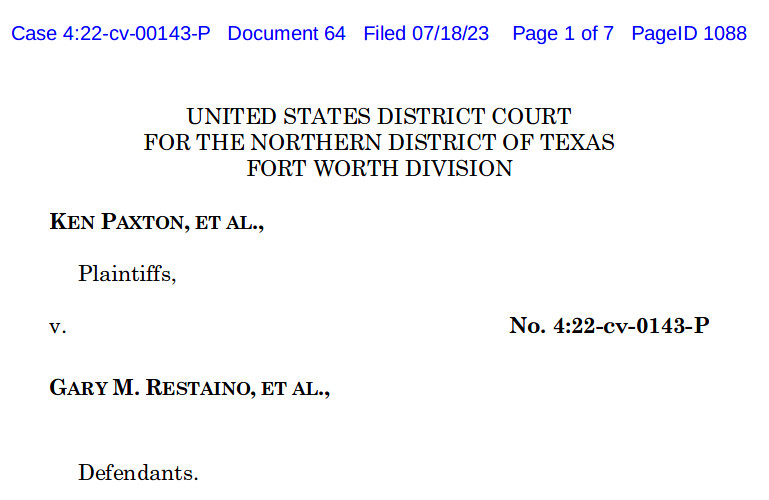
On July 18, Judge Mark T. Pittman of the Northern District of Texas, Fort Worth Division, ruled the plaintiffs in the case of Ken Paxton v. Gary M. Restaino ( Previously Dettleback, the case name changes with the name of the head of the ATF) have no standing to pursue the lawsuit, because they have not suffered a concrete harm. The case is dismissed without prejudice, which means it can be refiled with new evidence. The case is the result of passage of Texas bill HB 957. The bill required the Attorney General of Texas to file a lawsuit challenging the constitutionality of the federal law governing the possession and regulation of silencers.

On September 1, 2021, HB 957 became law.

The lawsuit was filed by Ken Paxton, Attorney General of the State of Texas, on February 24, 2022, as required by the passage of Texas Bill HB 957.  The arguments in the lawsuit were bolstered by the Bruen decision published on June 22, 2022. Having a federal law declared unconstitutional is a difficult thing to do. It used to be easier, before ideological Progressives took over the government, starting with President Theodore Roosevelt. Government was cut back a good bit with President Calvin Coolidge, ramped up with President Woodrow Wilson, and pushed into overdrive with the Franklin Delano Roosevelt administration and World War II. Since the Progressive revolution in the Supreme Court in the 1930's, the Court has been far less willing to overturn federal laws. The court has assumed a doctrine a law is presumed to be constitutional if passed by the legislature.

Entities challenging laws, must have "standing". Standing means they have an actual "concrete injury to a legally protected interest". But standing has become a way for judges to pick and choose the cases they want to hear. Judges have granted standing to people in environmental cases, because they have an "interest" in future appreciation of nature trails, for example.  It is hard to have standing against federal criminal law, without being charged with the crime in question. However, denial of Constitutional rights, even for a moment, is considered a concrete injury. Judge Pittman wrote, from the opinion:

 The guidance from our high court on standing continues to be “a morass of imprecision.”1N.H. Rt. to Life Pol. Action Comm. v. Gardner, 99 F.3d 8, 12 (1st Cir. 1996). At best, standing is now “unsettled in nature [and] beset with difficulties.” Thompson v. Cnty. of Franklin, 15 F.3d 245, 247 (2nd Cir. 1994). But luckily for this Court, though no one can pinpoint the height of the doctrine’s “amorphous” bar, it is easy to determine that these Plaintiffs have fallen short of it.

Judge Pittman notices the environmental case Paxton quoted as a way to claim Texas has standing in this instance, but Pittman does not accept the argument. From the opinion:

Texas does not seek to protect any interest remotely akin to the “earth and air within its domain.” Nor does Texas allege that it has any concrete or imminent injury specific to the state or its administration. See Biden, et al. v. Nebraska, et al., 143 S.Ct. 2355, 2358 (2023) (holding that Missouri established standing by showing that it “suffered . . . a concrete injury to a legally protected interest, like property or money”). By its own words, Texas seeks to protect the ability of its individual residents to make firearm silencers at home.

Second Amendment supporters would argue fundamental constitutional rights are every bit as important as regulating the emissions of cars or factories. Judge Pittman does not agree. No one, at this point, has ruled that silencers are protected arms, although they appear to meet all the criteria given in the Supreme Court decisions of Heller, McDonald, Caetano and Bruen. By ruling the plantiffs do not have standing, without prejudice, Judge Pittman removes himself from the case. Judge Pittman wrote an opinion favorable to the Second Amendment in a previous case. Judge Mark T. Pittman struck down the Texas law prohibiting 18-20-year-olds from carrying a handgun in public.

Analysis:

The case is likely to be appealed. It is not certain. Republicans who see AG Ken Paxton as a rival, and their Democratic party allies,  have impeached him. Paxton has been a target of repeated lawfare actions for several years. With the impeachment process going on, Paxton no longer is in charge of the Attorney General office. His replacement may not think the silencer case is important. We will find out in a couple of months.

The insane regulation of silencers/gun mufflers/suppressors is a puzzle to firearm users all over the world. Several countries have had virtually no regulation of the devices. It is difficult to understand why the heavy regulation in the United States was put into effect. Silencers are seldom used in crime. They have significant benefits to protect hearing, reduce sound pollution, aid in training and are more and more being used in the military. They have obvious advantages for defense of the home and for hunting.  Those who wish the population disarmed likely want to keep silencers heavily regulated precisely because of the many advantages of the devices.


©2023 by Dean Weingarten: Permission to share is granted when this notice and link are included.

Gun Watch


FL: Jewelry Store Employee Shoots at Armed Robbery Gang

As the woman was leaving after walking around for a few minutes, she held the door open for two men, one who was armed with a hammer, according to police.

The man with the hammer smashed a display case and grabbed multiple items, police said. The second man stood in the doorway and pointed a gun inside at employees and customers.

The store employee shot at the suspects, who left the area. A bullet hit an unoccupied car in the parking lot that belonged to someone who was not involved in the robbery, according to the Tampa Police Department.

No injuries were reported.

More Here

Sunday, July 30, 2023

Fifth Circuit Refuses to Grant ATF an Emergency Stay to save "Final Rule" on Receivers and Frames


On July 24th, 2023, a three judge panel of the United States Court of Appeals for the Fifth Circuit refused to stay the vacature of two challenged portions of the ATF Final Rule, in the case of VanDerStok v Garland. The preliminary injunction against enforcement of the frame and receiver portions of the Final Rule was issued by Judge O'Conner on August 17, 2022. The vacature is from the Memorandum Opinion by Judge Reed O'Conner, published on June 30, 2023, which vacated (ruled them to be unlawful) the Final Rule. 

Judge O'Conner, told the ATF (the Biden Administration) it did not have authorization from Congress to change the definition of what is a frame or receiver to include partially finished frames or receivers. The ATF did not have the authority to alter the definition of a firearm to include a weapons parts kit.  The ATF appealed to the Fifth Circuit three judge panel. The three judge panel refused to grant an emergency stay on the issues.  From the unpublished order on July 24, 2023:

Because the ATF has not demonstrated a strong likelihood of success on the merits, nor irreparable harm in the absence of a stay, we DENY the government’s request to stay the vacatur of the two challenged portions of the Rule. “[V]acatur . . . reestablish[es] the status quo ante,” Defense Distrib-uted v. Platkin, 55 F.4th 486, 491 (5th Cir. 2022), which is the world before the Rule became effective. This effectively maintains, pending appeal, the status quo that existed for 54 years from 1968 to 2022.

 The ATF is likely correct, however, that the vacatur was overbroad. The district court analyzed the legality of only two of the numerous provisions of the Rule, which contains an explicit severability clause. See 87 Fed.Reg. at 24730. Where a court holds specific portions of a rule unlawful, severance is preferred when doing so “will not impair the function of the [rule] as a whole, and there is no indication that the regulation would not have been passed but for its inclusion.” K Mart Corp. v. Cartier, Inc., 486 U.S. 281, 294 (1988); see also Sw. Elec. Power Co. v. EPA, 920 F.3d 999, 1033 (5th Cir. 2019)(vacating only challenged portions of a rule). Because the agency has shown a strong likelihood of success on its assertion that the vacatur of the several non-challenged parts of the Rule was overbroad, we STAY the vacatur, pending appeal, as to the non-challenged provisions.

and

We sua sponte EXPEDITE the appeal to the next available oral argument calendar. To allow time for additional proceedings as appropriate, this order is administratively STAYED for 10 days. 
The two specific issues in the final rule, which were upheld as vacated by Judge Reed O'Conner, are these, from the unpublished order:

First, the Rule expanded the ATF's authority over partially complete, disassembled, or nonfunctional frames and receivers that may be "readily converted" into "frames and receivers," when Congress limited the ATF's authority to only "frames or receivers" in the GCA. Second, another provision of the Rule unlawfully treats component parts of weapons, e.g., a weapon parts kit, as the equivalent of a firearm under the GCA.

Those two issues appeared so clear to the three judge panel, they did not grant an emergency stay to the ATF.

While the three judge panel of the Fifth Circuit did not grant an emergency stay, they administratively stayed the vacating of the order for ten days. Expect the ATF to appeal for an en banc hearing of the full Fifth Circuit Court of Appeals; or to appeal directly to the Supreme Court.

The reasoning of Judge O'Conner is clear. A part cannot both be a partial receiver and a receiver. A collection of parts and some tooling is not a firearm.

The three judge panel consists of Judges Smith, Southwick, and Wilson, Circuit Judges. We should find out what is happening with the non-challenged provisions of the Final Rule in the next 10 days.

This order does not deal with bump stocks or with pistol braces. There are other court cases dealing with those issues. 


©2023 by Dean Weingarten: Permission to share is granted when this notice and link are included.

Gun Watch


MI: Armed Samaritan Shoots Armed Robbery Suspect

CASSOPOLIS, MI (WKZO AM/FM) – Police in Cassopolis say a man who allegedly tried to rob a gas station in the village at gunpoint was himself shot by a customer at the station late Thursday night.

Village of Cassopolis Police Chief Todd McMichael says his department was dispatched to the attempted armed robbery and shooting at the Stone Lake Marathon at 221 South Broadway Street just before 10:00 p.m.

When officers arrived on scene, they found a male had been shot several times, and another male holding the suspect at gun point. Officers were able to determine that the male that was shot had attempted to rob the clerk, and was shot by the customer with the gun.


More Here

Saturday, July 29, 2023

Brazil: Private Gun Ownership up, Murder rate Down


Brazil President Jair Bolsonaro


One of Brazilian President Jair  Bolsonaro's campaign promises was to reform the extremely burdensome restrictions of the Brazilian legal code on the ownership and use of firearms. Ammoland related the drop in homicides as of early 2020, when the rate had dropped under 20 per 100,000 population. According to the Wilson Center, Progressive thinktank, legal private ownership of firearms grew from about 1.3 million in 2018 to just short of 3 million in 2022.

"Experts" claim the increase in armed citizens has nothing to do with the drop in the homicide rate. From the Wilson Center:

At first glance, this seems to lend credence to far-right former President Jair Bolsonaro’s view on fighting crime. He advocated the indiscriminate use of firearms by the general population as a policy to curb violence. Criminals would “think twice” before robbing an “armed, law-abiding citizen,” he argued. Gun registrations increased by nearly 80 percent between 2019 and 2022, the duration of Mr. Bolsonaro’s term.

However, experts deny that the drop in homicides last year is linked to Mr. Bolsonaro’s pro-gun, tough-on-crime discourse.

The Wilson Center's "80%" increase is difficult to decipher. In the chart they present, the total number of legal, privately owned guns increases about 127%, from 1.3 million to about 2.95 million. These numbers include private firearms owned by service members. If you exclude the firearms owned by service members, the numbers increase from about .65 million to 2.25 million, a 246% increase.  The 80% increase only makes sense if you start with the permits in the first year of Bolsonaro's term, after he had already issued his decree to start the rise in numbers.

Legal private ownership of firearms increased substantially during Bolsonaro's four year term, and homicide rates plummeted. The homicide rate dropped from nearly 31 per 100,000 in 2017 to 19 in 2022. Homicide rates in Brazil Have dropped to the lowest level since 1994.  From AP in Chron.com:

About 47,500 people were slain in Latin America's largest nation in 2022, said a report Thursday by the Brazilian Forum on Public Safety, an independent group that tracks crimes. Its statistics are widely used as a benchmark because there are no official statistics on a national level.

While the number of killings in 2022 was down 2.4% from the previous year, it remained roughly even with levels recorded since 2019. The last time Brazil had less violent deaths was in 2011, with 47,215 killings.

The reporting ignores the increase in the Brazilian population. Citing only raw numbers, for such a comparitson is lying with statistics. The rates of homicide are what should be compared, not the raw numbers. In 2011, using the numbers provided by AP, the rate was 23.8 per 100,000, considerably higher than the 22 as calculated from the AP figures for 2022.

Another source shows 40,800 murders registered, for a homicide rate of 19 per 100,000

Brazil experienced a small 1% drop in homicides in 2022, with 40,800 murders registered, according to the National Homicide Index created by media group Globo.

In 2021, the country registered 41,069 murders according to the same index.

From the various sources, the homicide rate fell from 1 - 2.4 % from 2021. As we see a homicide rate of 19 per 100k in 2022, we would have a rate of about 19.2 to 19.5 in 2021. The rates for 2017, 2018, 2019, and 2020 were, according to  the same macroterends article as above: 30.69, 26.72, 20.88, 22.45. Not only did the homicide rate drop, it stayed at about 70% of the level it had been at the high. The rate of homicide in Brazil had not been that low since 1994. The first effective restrictive firearms regulation was put into effect in 1997.

The "experts" predicted the homicide rate would rise precipitously with an increase in firearms ownership.

From Ammoland, on May 13, 2019, "experts" were predicting  a 2% increase in the murder rate for each 1% increase in the number of firearms in circulation. The number of firearms in circulation is difficult to measure and in dispute. The number of legal firearms in circulation more than doubled. The murder rate fell precipitously, as did the total number of homicides. As previously written, legal firearms ownership rates, illegal firearms ownership rates, and the regulation of firearms have no correlation with homicide rates.

How could the "experts" be so wrong? Because they start with the assumption more guns = more homicides. The assumption is false, as has been demonstrated in numerous countries, now including Brazil.

In science, an hypothesis is established, then a prediction is made about what an experiment will show. The experiment is conducted. If the results of the experiment agree with the predicted results, the hypothesis stands until more experiments show otherwise. The problem with real-world experiments, such as conducted during the four year term of President Bolsonaro, is there are numerous, uncontrolled variables. The basic numbers stand as shown. Gun laws restrictions were reformed, allowing more legal private ownership and carry of firearms. The murder rate dropped precipitously.

The newly elected, far-left President Lula (in a highly disputed election) is working hard to eliminate the Bolsonaro gun reforms.  From apnews.com:

Estimates of the number of guns in civilian hands more than tripled to 2.9 million in a country of 214 million people, according to the Instituto Sou da Paz, a non-profit that monitors public security.

(skip)

 “It’s one thing for the regular citizen to have a gun at home for his protection, as a guarantee, because some people think this is safety. Let them have it. But we cannot allow gun arsenals to be in the people’s hands,” Lula said Friday during a signing ceremony.

(skip)

 “We will keep on fighting for a disarmed country. Who should be well equipped with guns is the Brazilian police and the federal armed
forces,” Lula said.

When your basic assumption is the people should be disarmed, no amount of statistical evidence will persuade you to allow them to be armed.

Brazil has very few firearms compared to the United States. At the highest, its homicide rate was about five to six times that of the United States. Under Bolsonaru, the Brazilian homicide rate dropped. Under President Biden, the USA homicide rate increased. The Brazilian rate, now at 19 per 100,000 is only about 3 times the homicide rate in the United States.  The USA has about 450 million privately owned firearms. Brazil has about 2.9 million (according to the above article). The USA rate of firearms per person is 1.35, that of Brazil is about .0135, or only 1 percent of that of the USA.

With only 1/100 of the rate of firearms ownership in the USA, Brazilians murder about 3-6 times as many people per 100,000 population. This shows the number of firearms owned is virtually meaningless in accounting for the rate of homicide in a country.

The drop in the homicide rate in Brazil shows people who are likely to commit homicide can read papers and see the news. When they know more people are likely to be armed, they can alter their behavior.

©2023 by Dean Weingarten: Permission to share is granted when this notice and link are included.

Gun Watch

TX: Owner Tracks Down Car Theft Suspects, Gunfight Erupts while Holding Them for Police

The owner of a stolen vehicle shot the suspected culprits, resulting in the death of one of them, after tracing the car to a parking lot outside South Park Mall on Thursday afternoon, according to the San Antonio Police Department (SAPD).

SAPD Chief William McManus stated that the alleged thief fired the first shots after being ordered out of the vehicle at gunpoint by the owner while waiting for police to arrive. The owner was struck before firing back in response.


More Here

Friday, July 28, 2023

Right to Arms in Colonies Predated English Bill of Rights


New evidence has surfaced which indicates Englishmen in the American colonies had the right to keep and bear arms before the right was codified in England. In 1606, King James I granted perpetual rights to arms for the Virginia colonies, which covered what would become the southern colonies during the 1600s. From The History of Bans on Types of Arms Before 1900, by David Kopel and Joseph Greenlee, Law review article, 165 pages, 2021.

 In the early history section of the article, one startling fact revealed was the Royal Charter of King James  I, in 1606, granted to members of the Virginia Charter, perpetual rights to:

 bring “sufficient Shipping, and Furniture of Armour, Weapons, Ordinance, Powder, Victual, and other things necessary for the said Plantations and for their Use and Defence there.”

The rights were granted to all settlers of the Virginia colony.

The Charter of New England colonies were granted the same rights. The two charters covered all of what would become the original 13 colonies except for the middle region which contained New York, Pennsylvania, Vermont and New Jersey. Those colonies were originally part of New Netherland, and were conquered by England in 1664.

The English Bill of Rights was enacted by Parliament in 1689, just over a hundred years before the American Bill of Rights was ratified as part of the American Constitution.  Scholars have focused on the American Bill of Rights as deriving from the English Bill of Rights which was codified by the act of parliament in 1689. The King had granted perpetual rights to Englishmen in what would become the Southern and later, New England colonies, 83 years earlier.  The right to arms was stronger in the American colonies than it was in England, in part because arms were such a necessity of life while facing hostile tribes. Hunting for food was embraced in the colonies, but severely restricted in England, where game was considered the property of the landed class and the King.  The roots of the right to arms in America should properly be traced back to the Virginia Charter, establishing an 185 year history instead of a mere 100 year history from the Bill of Rights enacted by the English Parliament.

The necessity of arms was strongly punctuated by the massacre of colonists by Indians in 1622. In spite of the "perpetual" nature of the charter, the 1606 charter was revoked in 1624. The Virginia colony was placed under the direct control of the Crown. This was a strong reminder that monarchical power was not to be trusted.

The English and Dutch colonists were quick to adapt firearms technology which improved the utility of arms on the American scene. From  Arms and Armor of the Pilgrims, 1620-1692, by Harold L. Peterson page 18:

For the first ten years the supremacy of the matchlock was probably not seriously threatened. From 1630 until the outbreak of King Philip’s War in 1675, however, the change is plainly visible. There are more references to matches than to flints in inventories and court records until the beginning of the Pequot War, but the tales of snap-shooting [Pg 18] increase, and during the war the stories of ambushes and surprise attacks throughout New England indicate that flint arms were becoming more plentiful. In 1643 the Plymouth General Court ordered that every soldier should be supplied with either a matchlock or a “snaphance.” By 1645 Governor William Bradford could report that the Plymouth troops had been sent to a muster at Seacunk “well armed all with snaphance peeces.” In 1645, also, while matchlocks were allowed for private arms, the Plymouth General Court allowed only “snaphances” or “firelocks” for Town arms.

With the coming of King Philip’s War, the era of the matchlock at Plymouth was definitely past. The campaigns of that war, forays into the wilderness, night attacks, ambushes, battles in the rain, and encounters between individuals which required snap-shooting indicate clearly that the “snaphance” was the principal weapon. In 1677, towards the end of the war, the Plymouth General Court outlawed the matchlock completely as an acceptable weapon. In abandoning matchlocks at this time, Plymouth was years ahead of Europe where the clumsy firearm persisted until after 1700.

By the time of ratification of the American Bill of Rights with the Second Amendment in 1791, the American colonists had 185 years of experience in the necessity and utility of the right to arms. The experience of the Revolutionary War, where the British repeatedly attempted to disarm the American colonists, was probably the strongest example. It was fresh in the memory of the successful American revolutionaries (the founding fathers). The 170 years of previous experience had served to cement the right as long established before the war.

In addition, the doctrine of the natural rights of man had come to dominate thought of the founding fathers, which re-enforced the moral certitude of the right to arms.


©2023 by Dean Weingarten: Permission to share is granted when this notice and link are included.

Gun Watch


CA: Domestic Attempted Break-in, Wrong Address, Resident Shoots Attacker

The Carmichael shooting happened Sunday around 1 a.m. at the Olive Square Apartments on Fair Oaks Boulevard near Hollister Avenue. Sgt. Amar Gandhi, a spokesperson for the Sacramento County Sheriff's Office, said 33-year-old Alonzo Brown was trying to track his girlfriend down using his phone.

That led him to one of the apartment units, but his girlfriend was not there, Gandhi said. He tried to kick the door in and when that failed, he tried to break the window. When he saw someone inside, he shot at them.

But as Gandhi explained, that attack backfired for Brown.

"The best part about this was that the resident at the apartment who was a legal firearm owner actually fired back," Gandhi said.


More Here

IN: Brandon Sanchez Shot, Killed, Person Cooperating with Police

INDIANAPOLIS — A man is dead after being shot on the east side of Indianapolis overnight.

Around 3 a.m., officers with Indianapolis Metropolitan Police Department said they were called to 3366 Wallace Avenue for a report of a person shot.

According to police, when they arrived they found an adult male, later identified as 32-year old Brandon Sanchez, with gunshot injuries in front of the residence.

More Here

Thursday, July 27, 2023

Judge Benitez July 18 Hearing on California Ammunition Law, Rhodes v. Bonta

Senior Judge Rodger T. Benitez 


On July 18, 2023, Judge Roger T. Benitez heard statements from opposing attorneys on the former Rhode v Becerra, now Rhode v. Bonta lawsuit. There were no objections to combining the hearing on the preliminary injunction with the trial on the merits. This case was vacated by the Ninth Circuit Court of Appeals and sent back to Judge Benitez because of the Bruen decision at the Supreme Court.

The Rhodes v Bonta case deals with the Draconian restrictions which California enacted on the sale of ammunition within the state, and on the importation of ammunition from other states into California. The law may be the most restrictive law dealing with the purchase of ammunition ever enacted in the United States. Judge Benitez knows he is in a hostile environment in the Ninth Circuit. Judge Benitez is being extremely careful and diligent in his approach. All sides know, whatever the outcome, the case will be appealed to a three judge panel of the Ninth Circuit. From michaellawyers.com, Docket text  of the July 18, 2023 hearing:

Docket Text: Minute Entry for proceedings held before Judge Roger T. Benitez: Preliminary Injunction Hearing held on 7/17/2023. No objections were heard as to combining the preliminary injunction hearing with a trial on the merits. Within 30 days of today, Plaintiffs shall file a declaration(s) regarding their Article III standing. Within 30 days of today, Defendant shall name and file an expert report(s) or declaration(s) regarding the American history and tradition of background checks. Within 15 days thereafter, Plaintiffs shall decide whether to depose said expert(s), and within 30 days after deciding, Plaintiffs shall file a brief or expert declaration(s) in response. Additionally, within 30 days of today, Defendant shall file an updated declaration regarding ammunition purchaser background check acceptance/rejection rates and processing times, as performed previously. Additionally, within 30 days of today, Defendant shall report to the extent ascertainable, on persons described in previous declarations as persons who underwent background checks and were identified as prohibited persons and indicate whether such persons were prosecuted and whether firearms were located and seized from such persons.(Court Reporter/ECR Juliet Eichenlaub). (Plaintiff Attorney Sean Brady, Konstadinas T. Morou). (Defendant Attorney Christina R. B. Lopez, John D. Echeverria). (no document attached) (gxr)


Judge Benitez is also hearing cases under the guidance of the Bruen decision on the California magazine ban, the California "assault weapons" ban, and a California ban on "billy" clubs. Hawaii settled a lawsuit (in the Ninth Circuit) where the state essentially admitted a ban on billy clubs was unconstitutional. Judge Benitez originally held the "billy" club ban to be constitutional because of its age, under the old, discredited findings of the Ninth Circuit on how the Second Amendment was supposed to be interpreted. Under Caetano and  Bruen, this correspondent expects the law to be found unconstitutional.

The California Rifle and Pistol Association (CRPA) has reported, that at the hearing on July 18, Judge Benitez assured all parties he is working hard on all these cases. From the crpa.org:

Judge Benitez also assured everyone in court that he is hard at work on decisions in other Second Amendment cases pending before him, including CRPA’s Duncan case challenging the ban on magazines that can hold over 10 rounds, the challenge to the California “assault weapon” law, and a challenge to the state law banning possession of “billy” clubs. The Judge noted that his calendar has been especially busy,but also that he is taking the time to read, and will be addressing in his decisions, every bit of evidence and scholarship submitted in those cases. Considering the different rulings on these issues coming out from other federal courts in other states, we expect the decisions we eventually get will be the most thorough and comprehensive decisions yet issued by any court.

The CRPA is asking members to report instances where they have been refused the ability to purchase ammunition under the California ban, as a response to the claim the CRPA does not have "standing" to contest the ban.

Judge Benitez' published opinions on previous cases have been things of beauty in logic and reason. This has earned Judge Benitez the appellation of "Saint" Benitez in the eyes of Constitutionalists and Second Amendment supporters. Judge Benitez was born in Cuba. This may help explain his acute understanding of the Constitution and the Bill of Rights.

The numerous cases generated under the Bruen decision are working their way through the courts. Bruen holds the promise of restoring Second Amendment rights which have been heavily infringed for more than a century. To restore the rights under the Second Amendment, the proper procedures must be followed, and the Supreme Courts decision made more clear and certain through careful and clear lower court opinions. Judge Benitez is doing his job.

©2023 by Dean Weingarten: Permission to share is granted when this notice and link are included.

Gun Watch



IN: Domestic Defense? James More III Shot, Killed in Dispute with Woman

INDIANAPOLIS — IMPD detectives believe they know who shot a man whose body was found in a retention pond on the far west side of Indianapolis, but the shooter is not under arrest. 

First responders found the body of 42-year-old James Moore III in the Berkshire Lakes neighborhood pond, near South Raceway Road and West Morris Street, around 10:30 a.m. Sunday. But police believe he was shot in the neighborhood around 4 a.m. Saturday.

Police first came to a house in the neighborhood early Saturday on a report of shots fired. His wife, Vinecia Moore, told 13News that James was in a dispute with another woman at the address when he was shot by a man who lives there. 

James allegedly fled the scene. Police found his car and searched the area, even using a drone, but could not find him Saturday. His family says a trail of blood led to the pond where James' body was discovered Sunday morning.


More Here