Showing posts with label switzerland. Show all posts

Sunday, January 06, 2013

Swiss Facts vs American Propaganda: An Open Letter to Dr. Janet Rosenbaum


Dr. Rosembaum: It appears today that your efforts to publicize your research ("Gun Utopias? Firearm Access and Ownership in Israel and Switzerland," Journal of Public Health Policy 33, p. 47 (2012)) have accelerated. The most recent showcase for your paper and the concepts that underlie it happens to be Foreign Policy ("A League of Our Own," Foreign Policy (December 19, 2012)) but Ezra Klein showcased your research in an interview for his Washington-Post sponsored Wonkblog some days before ("Mythbusting: Israel and Switzerland are not gun-toting utopias," Wonkblog (December 14, 2012)). It is unfortunate then that the body of your research on Switzerland can only be described as "shoddy," at best. At worst it appears more like raw academic fraud.

Here in Switzerland we resent being pressed into forced labor in the salt mines of America's rapidly devolving culture wars, but this would be somewhat easier service to tolerate if your representation of Swiss law, statistics on firearms related deaths and homicides in Switzerland, and Swiss culture were remotely accurate. They are not. Not even close.

Moreover, it is the considered opinion of finem respice that you know it.

By your own admission your conclusions about Swiss firearms law are based on your own translation of the French and German versions of the "Bundesgesetz über Waffen, Waffenzubehör und Munition" ("Swiss Federal Law on Weapons, Weapon Accessories and Ammunition"), which your research cites repeatedly. Based on the conclusions you arrive at in your research it seems apparent that your foreign language skills leave much to be desired.

Almost nothing at all that you claim as fact about Swiss firearms law is true. Literally, no material point you have been making in public (3 month permit renewals, proof of "need" requirements to purchase firearms) in support of the premise that Swiss firearms regulation is "strict gun control" is correct.

Your command of Swiss gun violence statistics are equally flawed.

In fact, Swiss gun homicides stood at 0.2389 per 100,000 residents in 2010. This figure is among the lowest in the world. In Europe it is effectively indistinguishable from the rates in France and Denmark, and lower than Finland, Belgium, Ireland, Italy, Portugal, Greece, and Luxembourg.

Luxembourg is a particularly interesting case, being small and culturally fairly homogenous (as Switzerland). But there the similarities end. Luxembourg ranks 147th out of 178 countries for the rate of private gun ownership in the Small Arms Survey of 2007 (which you cite repeatedly in your research as an authority and which ranks Switzerland 3rd of 178 countries in the very same chart). Moreover, despite your flawed understanding of Swiss gun law, gun control measures in Luxembourg are generally stricter than Switzerland. This is true of most if not all EU members, as they have generally aggressively implemented the European Council Directive on "Control of the Acquisition and Possession of Weapons" from 1991.

Italy is also an interesting case with victims of homicide by firearm per 100,000 residents of 0.36 in 2009 (the latest year for which figures are available from the World Health Organization's "European Detailed Mortality Database"). That was almost 17% higher than Switzerland that year and is 33.6% higher than Switzerland's current rate. And where does Italy rank in rate of firearms ownership? 55th of 178 countries according to the same Small Arms Survey data from 2007.

In fact, despite your absurd claims that ownership of firearms in Switzerland is "rare," the same data shows that Swiss civilians are better armed than the populations of Northern Ireland, Lebanon, Kosovo, Angola, Bosnia-Herzegovina, Libya, Mexico, Guatemala, South Africa, Pakistan, Jordan, Brazil, Nicaragua, Iran, El Salvador, Mozambique, Afghanistan, Zimbabwe, Myanmar, Syria, Egypt, Palestine, the Ivory Coast, Liberia, Laos, Chad, Sierra Leone, Rwanda, and Ethiopia. Perhaps now is a good moment to remind you once again that you cite the same report from which these figures are drawn repeatedly in your research?

Of course, it is habit among lazy scholars to attribute high rates of private ownership of firearms in Switzerland to the "militia." Unfortunately for those who argue this point, it is demonstrably false.

Admittedly, it is often difficult to get a handle on the total number of privately held firearms in Switzerland. This is because not all firearms have to be registered here.

Still, back in 2011 to inform citizens on the facts regarding firearms in Switzerland for the upcoming referendum, the Bundesamt für Statistik (The Swiss Federal Statistics Agency) published a series of figures on firearms, firearms deaths, and firearms violence. The agency estimated the total number of privately held firearms at 2,000,000 (though your source, the Small Arms Survey of 2007 cites the higher figure of 3,500,000 for its main calculations and suggests that figure might even be as high as 4,500,000). Of these:

Around 260,000 firearms are select-fire Sturmgewehr 90s (the "SIG 550" in the civilian market) held by members of the Swiss armed forces in connection with their current military service obligations. This is between 7.43% (using your source, the Small Arms Survey of 2007) and 13% (using the Bundesamt für Statistik estimates). If one takes the high end of the Small Arms Survey of 2007 the figure sinks to 5.78% of the total. In short, firearms ownership owing to current militia service is a small fraction of total firearms in private hands in Switzerland.

These are not secret figures by any means. One need only know how to download a spreadsheet from the official Bundesamt für Statistik site (although that would require a working knowledge of German or French, or the effort to walk to your local linguistics department and ask for a translation) or download the Small Arms Survey report from 2007 (which you obviously already had access to as it is cited in your work).

In the case of the former, the crime reports and population counts in Switzerland going back 10 years or more are readily available. These form the basis of the statistics cited here and should have influenced your research, though perhaps you would not have been able to talk Foreign Policy into giving you a four-page spread with the boring conclusions vis-a-vis Switzerland that would have resulted.

On reflection, so contorting are the intellectual acrobatics you go through to avoid these facts it becomes difficult to see anything other than academic malfeasance in support of advocacy (rather than science) at work here. But mere data cherry-picking is not the limit of the flaws in your arguments.

Many "scholars" in this area like to conflate "gun violence" with "deaths by firearm." You have been no exception. In fact, there is a strong argument that you have been among the worst offenders in this regard over the last 10 days. So let's look at total firearms related deaths in Switzerland, shall we?

At 3.0297 per 100,000 residents in 2010, total firearms related deaths in Switzerland ranks somewhat higher with respect to her peers. These figures are the sum of accidents and suicides, however. Using them as indicators of "gun violence" is to torture the definition of that term beyond recognition. Even this higher rate is, however, on par with France, and below Finland, and Canada.

Resorting again to the Bundesamt für Statistik we find that suicides account for a large part of these figures, but suicide by firearm is small as a percentage of total suicides. One of the effects of having a very low level of overall fatalities not due to natural causes is that small figures have big effects on ratios and percentages.

For the last five years total suicides by firearm have ranged from a high of 264 (in 2007) to a low of 222 (in 2010) or between 18.2% and 22.9% of the total. As a method, "hanging" beats firearms by several percentage points every year, "poisoning" exceeded firearms by as much as 12 percentage points from 2002 to 2009 (when assisted suicide figures were removed from the totals- the Swiss do not generally consider these "crime" figures, you understand) and alternates as the higher figure with "other methods" in the last five years.

As a policy matter, even if you cut suicides by firearm in Switzerland by 25% and assumed that those prevented never resorted to other methods (a highly dubious assumption) you are only talking about 55-65 suicides per year. You have to format excel to show six decimal places to see that this is 0.000062% of the population of Switzerland.

Perhaps this is a Swiss attitude, but curtailing the rights of nearly 9 million residents to prevent 0.000062% of the population from voluntarily ending their own lives seems slightly excessive.

Finally, there is the matter of your gross misrepresentation of trends in Swiss gun control, which you have repeatedly alleged is on the rise, or that Switzerland is "moving towards" greater control, whatever that means. Here your conduct has been so egregious it becomes difficult to believe that major American Universities have played host to your activities.

Any serious scholar of Swiss firearms policy would have known that in 2011 the Swiss held a popular referendum calling for more gun control, supported in large measure by the same organizations which pressed the Switzerland to join the European Union (a bullet Switzerland thankfully dodged). The gun-control measure was thoroughly trounced.

Switzerland requires referendums to pass both the popular vote by a majority and also carry a majority of the kantons. The referendum lost the popular vote by 12.6 points and carried only 35% of the kantonal electoral votes. Contrary to your absurd suggestions, gun control advocates have been oddly silent in Switzerland since the referendum.

Yesterday, finem respice called for you to retract your paper and publicly correct your flawed representations of Swiss firearms law, and firearm homicide and death rates in Switzerland. Now that you have been made aware of the real and material flaws in the body of your research that pertains to Switzerland it would be difficult to regard as anything other than academic dishonesty a refusal by you to publicly correct your position. Accordingly, and as finem respice indicated yesterday, if such a correction and retraction is not forthcoming within 10 days finem respice will formally submit its findings in support of charges of academic dishonesty to the University of Maryland, the institution you were affiliated with when the instant research was conducted, the State University of New York, where you are currently an Assistant Professor, and the Journal of Public Health Policy, which published your flawed study.

Of course, finem respice awaits your prompt and comprehensive reply.

Source: finemrespice.com

Thursday, January 03, 2013

European Murder Rates Compared to the United States: Demographics vs Guns


When the subject is gun control, those who demand more for the United States always point to Europe. Europe, they say, has more gun control than the United States, and lower murder rates. Europe, of course, is a diverse place. Some places have lots of guns and low murder rates. Some places have few guns and higher murder rates. The reason that many developed European countries have murder rates much lower than the United States is not guns or gun control. It is demographics.

In 2006 the Department of Justice issued a report on violent felons in large urban counties. It covered the period from 1990 to 2002, and included the 75 most populous counties in the United States. The study accounted for over half of all the murders in the United States in the covered period.

Revealed in the study was a simple breakdown of the demographics of the murderers that is not commonly available. Murderers were divided into three groups. Blacks were the most numerous at 46%. Hispanics were next at 27 percent. Non-Hispanic whites were last at 23 percent.

While the study does not account for all murders in the period studied, it accounts for more than half and almost certainly slightly understates the percentages of Black murderers, because the latest FBI statistics (for 2010) show that when all the murders in the U.S are taken into account, the percentage of Black murderers is over 53 percent.

No one would dispute that there are several distinct cultures among the American black population. No one would dispute that none of these cultures exist in Europe in any statistically significant numbers. Some of the Black American subcultures probably have very low murder rates. We cannot tell because we do not have the data to distinguish between them.

Similarly, there are a number of distinct Hispanic cultures in the United States. These are all derived from cultures in Mexico, Central and South America, and the Caribbean. They are not Spanish or Portuguese. No one would argue that any statistical number of these populations exist in Europe. No doubt, some of these cultures also have very low murder rates, but without data, we cannot separate them out.

Where does that lead us? If we take the 23 percent figure for non-Hispanic whites to be representative for the entire population (remember, it is likely a good bit lower), then the number of murders committed by non-Hispanic and non-black people in the United States for 2010 would be 2989.

The population of non-Hispanic whites for 2010 was 196.8 million. Applying the 2989 murders to this population gives a murder rate of 1.52 per 100,000 population. We cannot get a more precise figure unless we have more demographic data than that given. Asian-Americans, for example, have historically had very low murder rates, but we do not have the data. The 1.52 per 100,000 murder rate is right in the middle of the murder rate of developed European countries. Add the Black and Hispanic numbers back into the mix and apply to the entire United States population, and the murder rate goes up to 4.8 per 100,000. Guns or gun control simply do not correlate to higher murder rates, particularly when you consider that non-Hispanic Whites own guns at much higher rates than do Blacks or Hispanics in the United States.

There are huge numbers of German-Americans, English-Americans, Greek-Americans, Italian-Americans, Scandinavian and Swiss-Americans in the United States. There are no statistically significant numbers of African-American or Hispanic-Americans in Europe.

As a check, you might consider a non-European example. Japan has extreme gun control and extremely low murder rates. The FBI used to track murders by Japanese-Americans before 1980, when access to firearms was relatively easy.  The murder rate of Japanese Americans was less than half that of Japanese in Japan.

Murder rates are driven by cultural background, not by the instrument used.

European murder and gun ownership rates: Link

Department of Justice Study with demographic data: Link

FBI homicide statistics, 2010: Link

Japanese and Japanese American murder rates: Link

Household Gun Ownership Rates: Link

Link to Teen Homicides by Ethnicity, 2010 
"In 2010, the homicide rate for black male teens was 51.7 per 100,000, more than 22 times higher than the rate for white male teens (2.4 per 100,000). Rates for other groups were 17.9 per 100,000 for Hispanic males, 11.9 per 100,000 for American Indian males, and 3.2* per 100,000 for Asian and Pacific Islander males. (Figure 3)"

Update: Here is a chart showing murder rates during the Middle Ages in Europe. Murder rates then were close to what is seen in African American cultures in the United States today, indicating that it is a cultural, not a racial relationship.
 Link: Homicide Rates Before Guns?


Update: Murder victims in DC support the hypothesis, given that the vast majority of murder is intraracial:

In fact, white residents face a lower homicide victim rate in the District than the nation as a whole. Nationally, 2.7 white residents are homicide victims per 100,000 white residents. But, among DC white residents, this figure is lower both when looking at data from either of the most recent two years (zero and 1.3 in 2009 and 2010, respectively) or the latest 5-year average (1.5). 
Here is a Yale study showing that cultural links are the biggest factor in predicting homicides:

Yale Study Shows Culture the biggest factor in Homicide (2013)
 Overall, the community's five-year homicide rate was 39.7 per 100,000 people, which was still much higher than the averages of other areas of Chicago (14.7 per 100,000). But being a part of that network of co-offenders, essentially just being arrested, raised the rate to by nearly 50 percent, to 55.2 per 100,000. What's more, being in a network with a homicide victim increased the homicide rate by 900 percent, to 554.1 per 100,000.

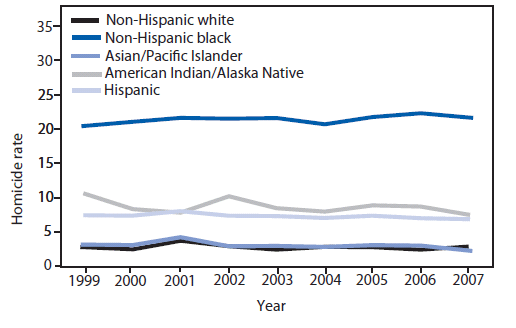
Here is some more data from the National Center for Injury Prevention and Control (CDC).  This data covers the period 1999  to 2007:

Tables for Homicide rates 1999 to 2007 by ethnicity:

Link to article with above graph


Update: Article that shows that mass murderers are not committed disproportionately by white men:

Link to article: Are Most Mass Murderers Really White?

Update: Family Structure and crime


Although there is a large disparity between the crime rates of whites and those of African-Americans,14 any perception that this is based solely on racism quickly evaporates when family structure is considered in the data. When researchers control for marriage, the rates of crime for whites and blacks in each family group are very similar.
Update: Another author comes to the same conclusion, but when you factor in illegal aliens, the murder rate drops even further.

Murder Most Swedish at the American Thinker

©2013 by Dean Weingarten: Permission to share is granted when this notice is included.
Link to Gun Watch


Tuesday, December 11, 2012

Switzerland Gun Control and History


So let's take a step back, and look at Switzerland's unique gun laws and culture.

"While traveling around Switzerland on Sundays, everywhere one hears gunfire, but a peaceful gunfire: this is the Swiss practicing their favorite sport, their national sport. They are doing their obligatory shooting, or practicing for the regional, Cantonal or federal shooting festivals, as their ancestors did it with the musket, the arquebus or the crossbow. Everywhere, one meets urbanites and country people, rifle to the shoulder, causing foreigners to exclaim: 'You are having a revolution!'" These words were written by General Henri Guisan, commander in chief of the Swiss Militia Army, the year before World War II began.

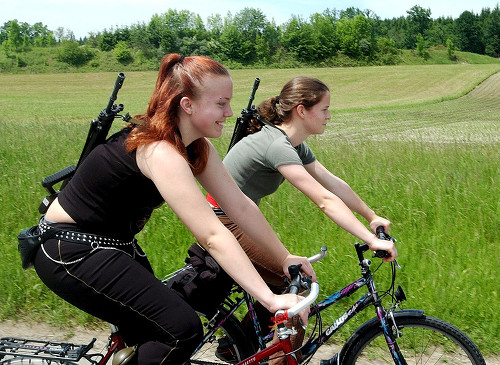
Having participated in Swiss shooting matches for over a decade, Stephen Halbrook can attest to the continuing validity of this statement. Throughout the country, people are free to come and go for shooting competitions, and competitors are commonly seen with firearms on trains, buses, bicycles, and on foot.

In 1939, just before Hitler launched World War II, Switzerland hosted the International Shooting Championships. Swiss president Philipp Etter told the audience, which included representatives from Nazi Germany:

There is probably no other country which, like Switzerland, gives the soldier his weapon to keep in the home.... With this rifle, he is able every hour, if the country calls, to defend his hearth, his home, his family, his birthplace.... The Swiss does not part with his rifle.

Switzerland won the service-rifle team championship. The lesson was not lost on the Nazi observers.

Halbrook details in Target Switzerland: Swiss Armed Neutrality in World War II, the Swiss militia policy of a rifle in every home deterred a Nazi invasion. A Nazi attack would have cost far more in Wehrmacht blood than did the easy conquests of the other European countries, whose governments had restricted firearm ownership before the war. Many hundreds of thousands, perhaps millions, of Swiss — and refugees who found sanctuary there — were saved because every Swiss had a rifle, and was prepared to resist.

To this day, every male, when he turns 20, is issued a full automatic military rifle and required to keep it at home. Universal service in the Militia Army is required. When a Swiss is no longer required to serve, he may keep his rifle (converted from automatic to semi-automatic) or his pistol (if he served as an officer).

American Founding Fathers such as John Adams and Patrick Henry greatly admired the Swiss militia, which helped inspire the Second Amendment to the U.S. Constitution — the preference for a "well regulated militia" as "necessary for the security of a free state," and the guarantee of "the right of the people to keep and bear arms." Late in the 19th century, the American military sent observers to Switzerland in hopes of emulating the Swiss shooting culture.

The American Founders also admired Switzerland's decentralized system of government. Switzerland is a confederation in which the federal government has strictly defined and limited powers, and the cantons, even more so than American states, have the main powers to legislate. The citizens often exercise direct democracy, in the form of the initiative and the referendum. The late political scientist Gianfranco Miglio said the Swiss enjoyed the "last, real federalism in the world," as opposed to the "false and/or deteriorated" federalism of Germany or America.

For centuries, the Swiss cantons had no restrictions on keeping and bearing arms, though every male was required to provide himself with arms for militia service. By the latter part of the 20th century, some cantons required licenses to carry pistols, imposed fees for the acquisition of certain firearms (which could be evaded by buying them in other cantons), and imposed other restrictions — albeit never interfering with the ever-present shooting matches.

In other cantons — usually those with the lowest crime rates — one did not need a police permit for carrying a pistol or for buying a semiautomatic, lookalike Kalashnikov rifle. A permit was necessary only for a non-militia machine gun. Silencers or noise suppressors were unrestricted. Indeed, the Swiss federal government sold to civilian collectors all manner of military surplus, including antiaircraft guns, cannon, and machine guns.

In 1996, the Swiss people voted to allow the federal government to legislate concerning firearms, and to prohibit the cantons from regulating firearms. Some who favored more restrictions (as in other European countries) saw this as a way to pass gun-control laws at the federal level; those who objected to restrictions in some cantons saw it as a way to preempt cantonal regulation, such as the former requirement in Geneva of a permit for an air gun.

The result is a federal firearms law that imposes certain restrictions, but leaves virtually untouched the ability of citizens to possess Swiss military firearms, and to participate in competitions all over the country.

The Federal Weapons Law of 1998 regulates import, export, manufacture, trade, and certain types of possession of firearms. The right of buying, possessing, and carrying arms is guaranteed with certain restrictions. It does not apply to the police or to the Militia Army — of which most adult males are members.

The law forbids fully automatic arms and certain semiautomatics "derived" therefrom; but Swiss military assault rifles are excluded from this prohibition. (The exclusion makes the prohibition nearly meaningless.) Further, collectors may obtain special permits for the "banned" arms, such as submachine guns and machine guns.

In purchasing a firearm from a licensed dealer, a permit is required for handguns and some long guns, but not for single-shot rifles, multi-barrel rifles, Swiss bolt-action military rifles, target rifles, or hunting rifles. Permits must be granted provided the applicant is at least 18 years old and has no disqualifying criminal record. Authorities may not keep any registry of firearms owners. Private persons may freely buy and sell firearms without restriction, provided that they retain a written agreement, and that the seller believes the purchaser is not criminally disqualified.

A permit was already required for manufacturing and dealing in firearms, but now there are more regulations still. Storage regulations exist for both shops and individuals. During the Cold War, the government required every house to include a bomb shelter, which today often provide safe storage for large collections of firearms (and double as wine cellars).

Criminal penalties depend on intent. Willfully committing an offense may be punishable by incarceration for up to five years, but failure to comply through neglect, or without intent, may result in a fine or no punishment at all.

Before 1998, about half the cantons (like 33 American states) allowed all law-abiding citizens to carry handguns for protection in public; in some cases, an easily obtainable permit was needed. The new federal law makes permits necessary everywhere, and, so far, permits have been issued restrictively. (Still, one can freely carry a handgun or rifle to a shooting range, and there is one in every village, nook, and cranny.)

Zug, site of the September murders, had always been a difficult place to obtain a handgun carry permit (Waffentragschein). Even if permits had been issued readily, it might not have made a difference on September 27, since, as one of our Swiss friends put it: "the mental climate of Zug was entirely peaceful. While I would — before the outrage — not at all have been surprised to learn that in the Uri or Ticino or the Grisons assembly there were members carrying arms, in Zug I would have been surprised indeed. This is exactly what the mad felon exploited, a state of mind. There are more parallels between the hideous September crimes than first meet the eyes!"

Any proposed new restrictions on peaceable firearm possession and use will be opposed by the Militia Army; by shooting organizations, such as the Swiss Shooting Federation; and by the gun-rights group ProTell, named after William Tell, who shot an apple off his son's head. Their allies are the political parties that support free trade, federalism, limited government, non-interventionism, and remaining independent from international organizations such as the European Union or United Nations.

Supporters of firearm restrictions tend to be socialists and Leftists — including those who wish to abolish the Militia Army, to strengthen the central government to be more like Germany, and to join the European Union. Ironically, the Swiss Socialist Party went through a similar period at the beginning of Hitler's rise. But the Swiss socialists soon recognized the danger, and in 1942 — when Switzerland was completely surrounded by Axis dictatorships — the Socialist Party resolved that "the Swiss should never disarm, even in peacetime."

Since September 27, the European media have been complaining about this "armed country" where every citizen is a "potential sniper." But the fact is, Switzerland is just as safe as countries where firearms are far more restricted. In 1994, the homicide rate in Switzerland was 1.32 per 100,000 in the population. Of those, 0.58 (44 percent) involved firearms. Compare this to Italy 2.25 (1.66 firearms), France 1.12 (0.44), and Germany 1.17 (0.22).

The Swiss household gun-ownership rate is 27 percent excluding militia weapons. Contrast this with the household gun-ownership rates (at least for households willing to divulge gun ownership to a government-affiliated telephone pollster) of 16 percent for Italians, 23 percent for French, and 9 percent for Germans.

The far left has been demanding massive new gun control, and prohibition on keeping militia rifles in the home. The Defence Minister has ruled out such changes, however. The Justice Department will push for an amendment to the federal gun law which would abolish private firearms transfers; all private transfers would require police approval.

While most of Switzerland's less-armed neighbors are as peaceful as Switzerland, danger emanates from the Balkans — the former Yugoslavia and Albania — not to mention from the chaos that's followed the breakup of the Soviet Union. Political terrorists and organized criminals are swamping Europe. Indeed, the same terrorist organizations that murdered Americans on September 11 operate in all European countries, including Switzerland. The new Swiss federal-weapons law is in part a reaction to this turmoil. But given that terrorists may buy black market AK-47s from the former Red Army in all European countries, the Swiss federal law impinges more on law-abiding Swiss than it does on foreign miscreants.

One wonders whether more gun laws will do as much good for Switzerland as would imprisoning people who threaten bus drivers with a gun, or improving supervision of released felony sexual predators against children.

Source

Monday, December 10, 2012

Swiss Gun Murders Lower Than Reported


Whenever international comparisons of homicide rates are studied, it is mandatory to consider Switzerland. Not only does Switzerland have very low homicide rates, it has one of the highest levels of gun ownership in the world.

As I attempted to find out what the gun homicide rate for Switzerland was, I ran into a curious phenomena. The most commonly quoted figures for gun homicides were for both gun homicides and attempted gun homicides. In one source, this led to the startling conclusion that gun homicides for a given year were greater than total homicides. At the site gunpolicy.org, the total homicides for 2009 are listed as 51. The total gun homicides are listed as 55.

Though a little research, I found that what most writers are seeing is the composite figure for both attempted and fatal gun homicides. As the attempted gun homicides outnumber the fatal gun homicides, this has a large impact on the number of total gun homicides claimed and on the rate of firearm homicides claimed in Switzerland.

Because of the referendum on gun control held in 2010, figures were published giving the actual gun homicides for four years. These were 1998, 2007, 2008, and 2009. The number of attempted homicides with firearms was given for 2009.

Here are the numbers:

In 1998, 53 homicides with firearms for a rate of .75/100,000

In 2007 27 homicides with firearms for a rate of .35/100,000

In 2008, 20 homicides with firearms for a rate of .26/100,000

In 2009, 24 homicides with firearms for a rate of .31/100,000

In 2009 the number of attempted homicides with firearms was 31.

These are exceptionally low rates. They are lower than the rates of Australia and Canada, both of which have much more restrictive gun control schemes. They are slightly higher than France and Sweden, though the overall homicide rate (Which, after all, is the more important number) is slightly higher in those countries, again, with much more restrictive gun control.

Here is a link to the source for the actual number of homicides with firearms. You have to subtract the suicides with firearms from the total number of homicides and suicides with firearms to find the actual number of fatal firearm homicides.