Friday, November 25, 2016

How President Trump can Defang Federal Gun Free Zones


President elect Trump has promised to do away with Gun Free Zones. Because of multitudinous, overlapping, Federal, state, and local statutes, ordinances and regulations, President Trump will not be able to eliminate all Gun Free Zones immediately. He can, unilaterally, do away with enormous swaths of them from the oval office, with a pen and a phone.

The key is to understand how these zones have been constructed.  The Federal zones consist of three large pieces and a multitude of smaller chunks. The three large pieces can be eliminated by executive order and findings from the executive branch.

The three large pieces are:
  • Military bases and installations.
  • Property managed by the Army Corps of Engineers
  • Post Office properties and other Federal properties and Buildings
President Trump's executive actions will rest on a solid basis of law. The fundamental base is the Second Amendment.

The next layer is the interpretation of the Second Amendment by the Supreme Court in the Heller and McDonald decisions.

The third layer is precedent set in the Gun Free School Zone Act of 1995.

A key finding of the Heller and McDonald decisions is that individual bearing of arms for purposes of confrontation is protected by the Second Amendment and is a lawful purpose for carrying arms.

The Gun Free School Zone Act of 1995 reinforces this understanding by exempting people who have valid carry permits from the penalties of the Act.

The Law Enforcement Officers Safety Act (LEOSA) makes provisions for active duty and retired law enforcement officers to carry in most of the nation.

Most Federal gun free zones are based on interpretation of 18 U.S. Code § 930 - Possession of firearms and dangerous weapons in Federal facilities.

The relevant paragraphs are (a) and (d).
(a) Except as provided in subsection (d), whoever knowingly possesses or causes to be present a firearm or other dangerous weapon in a Federal facility (other than a Federal court facility), or attempts to do so, shall be fined under this title or imprisoned not more than 1 year, or both.

(d) Subsection (a) shall not apply to—
(1) the lawful performance of official duties by an officer, agent, or employee of the United States, a State, or a political subdivision thereof, who is authorized by law to engage in or supervise the prevention, detection, investigation, or prosecution of any violation of law;

(2) the possession of a firearm or other dangerous weapon by a Federal official or a member of the Armed Forces if such possession is authorized by law; or

(3) the lawful carrying of firearms or other dangerous weapons in a Federal facility incident to hunting or other lawful purposes.
President Trump can and should issue, or work with the Attorney General to have issued, a finding that the bearing of arms with a valid carry permit or under LEOSA, is a lawful purpose under paragraph (3).

This is a commonsense and clear finding that 90% of the nation would immediately accept as valid. It merely reinforces the Heller and McDonald decisions. It enforces existing Federal law. Very few people would argue that carrying a weapon with a valid carry permit, for defense of self and others, is not a lawful purpose.

It eliminates most of the gun free zones of the Post Office and other Federal properties and buildings.  It removes a layer of resistance from military gun free zones and Army Corps of Engineer lands.

For Military installations, draft a DoD Directive to this effect:

As of (effective date) commanders shall allow persons with valid carry permits to access the same areas of military installations and lands under military control, that are available to unescorted access by armed members of local law enforcement agencies.

This takes into account sensitive areas, areas that require security clearances, and any other areas where there is a legitimate need to exclude armed members of the public, such as prisons.

The record is clear, from a number of states, that people with valid carry permits are more law-abiding than police officers.  The directive could state this fact as a valid reason for the change in policy. It could also cite the Supreme Court decisions in the Heller and McDonald cases.

A separate DoD directive should be developed for active duty military members.

The Army Corps of Engineers is partly taken care of by the actions above. The Corps of Engineers has court actions ongoing in the Ninth and Eleventh circuits.  As chief executive, President Trump could direct the Army Corp of Engineers, which falls under his command, to negotiate a Court sanctioned settlement. The settlement would permanently prohibit the Corps of Engineers from violating the Second Amendment. Such Court sanctioned agreements have long been used to create law without congressional approval, law that is impossible to remove by regulatory means. President Trump could find, with an executive order, that such a settlement would be followed by the Corp of Engineers in all other Circuits.

If Court actions were directed against other federal agencies under 18 U.S. Code § 930 (d) (3), President Trump could then direct negotiated settlements to the same effect as with the Army Corps of Engineers, for the entire Federal Government. Buildings directly controlled by the legislative branch and the Federal Court system would be excepted. 

The executive actions could be done in a very short period of time. Except for the court negotiated settlements, they could be reversed by the next president.

Legislative action would be necessary to prevent that option. The executive action would be a positive spur to legislative action.

Donald Trump has championed the passage of National Reciprocity.  A National Reciprocity bill could include direction on all three of the Federal areas listed above. National Reciprocity is already highly popular and likely has the votes to pass.

If National Reciprocity does not pass before the 2018, President Trump can use it to push his agenda in the mid term elections. The necessity of legislative action would be a rallying cry to Second Amendment supporters across the country to push for the election of congressional allies.  Such a cause, which resonates with Trump supporters, could be critical for senators in 2018.

©2016 by Dean Weingarten: Permission to share is granted when this notice and link are included.

Link to Gun Watch

FL: "Straw Purchase" v. Discrimination Crossfire Demonstrated


Two teenagers go into a gun store. One is white. The other is black, and a Muslim. The white teen is advising the black teen on what to buy. Is it a "Straw Purchase"? Several stores have been sued for millions of dollars because they legally sold a gun to someone who later committed a crime.

Gun retailers have been exhorted to be careful in who they sell to. They have been told to exercise judgment. They have been told that when in doubt, refuse to sell. The Reese family in New Mexico, had their lives ruined, and spent a year in jail on such charges.

This is a pincer movement from gun haters. When a retailer refuses to sell because they are uncomfortable, they will be labeled as discriminatory. Gun retailers have, quite deliberately, been put into a no-win scenario. The "discrimination" side of this squeeze play was demonstrated in Florida at a Bass Pro store. From wcjb.com:
Bakr said, "There was an older gentleman there and he was kind of looking at me and I thought it was kind of strange, I told him something was kind of shady because he was staring at me and staring at the dude that was working with me."

Bakr went through the entire firearms buying process, and paid the $5 for the background check.

"That's when he told me he didn't feel comfortable selling me the firearm because he said that since I was with Heath, they thought I was going to buy it and give it to somebody younger," Bakr said. However, Smiley is 19, and has been sold guns before
.
The whole idea of stopping criminals and miscreants from obtaining guns by doing checks at the retail level is flawed.  It does not accomplish its stated purpose, because it is so easily circumvented.

If a person wants a gun to do evil, they are either legally prohibited or not. If they are not prohibited, they can buy a gun.  If they are prohibited, they can have someone else buy for them or purchase a gun that is stolen or manufactured in the black market.  There are nearly 400 million guns existent in the United States. Retail checks have been shown themselves to be ineffective in preventing crime in any measurable way.

What retail checks do is make it difficult for marginally motivated buyers, such as Bakr, to become gun owners. The vast majority of people prevented from buying guns are not a threat to anyone.  The effect of retail background checks is a chilling of the exercise of the Second Amendment.

The history of infringements on the Second Amendment is a history of racial discrimination.   Robert Sherrill, in The Saturday Night Special, wrote that the purpose of the 1968 Gun Control Act, which initiated the national regulation of guns at the retail level, was to keep guns from inner city black people.

The approach did not work, and it never has worked.  The crime and homicide rate skyrocketed after the 1968 law was passed. It did not come down until the revolution in legalizing concealed carry was underway.

We would be better served by repealing the entire 1968 law, and concentrating on removing guns from those who are legally prohibited from having them.

That is the approach used by project Exile.  It is the approach promoted by Harvard scholar David Kennedy.   It requires that police work with communities to concentrate on bad actors. This results in more legitimacy for the police.  When that happens, there are spectacular reductions in homicides.  It is the opposite of the approach in the Barack Obama administration, which promotes the de-legitimization of police.  That approach has resulted in the Ferguson Effect, enormous increases in urban homicides, and increased homicides of police officers.

Donald Trump has mentioned project Exile. He would do well to bring David Kennedy on board as a crime policy advisor.

Repealing the counterproductive GCA 1968 would be a positive step. I do not expect it in a Trump first term.

©2016 by Dean Weingarten: Permission to share is granted when this notice and link are included.

Link to Gun Watch

TX: Off Duty Deputy Shoots Robbery Suspect


An employee at the restaurant, Bralin Henderson, said a man with a gun ran for the cash register and grabbed a manager. The off-duty deputy working security confronted him, he said.

Henderson said the robber refused to drop the gun.

According to the Montgomery County Sheriff's Department, the man pointed his gun at the deputy and the deputy, shot the man several times. The man died at the scene.
More Here

MS: Armed Woman Stops Robbery, Wounds Friend

Police said the woman inside began shooting and accidentally shot the man who was there with her. The would-be robber dropped his gun and ran away, police said.

More Here

Thursday, November 24, 2016

Caetano Used to Challenge another Stun Gun Ban


On 21 March of 2016, the Supreme Court issued a remarkable and, apparently to the Court, non-controversial decision.  In the Caetano PER CURIAM decision (pdf), the Court held that:
The Court has held that “the Second Amendment extends, prima facie, to all instruments that constitute bearable arms, even those that were not in existence at the time of the founding,” District of Columbia v. Heller, 554 U. S. 570, 582 (2008), and that this “Second Amendment right is fully applicable to the States,” McDonald v.Chicago, 561 U. S. 742, 750 (2010).
While the decision, which was unanimous, has far reaching implication beyond mere stun guns, stun gun bans have already started falling like dominoes.

Massachusetts, perhaps surprisingly, has done nothing about their law, leaving it in limbo. Prosecutions remain unlikely.

New Jersey is in the process of reforming its ban on stun guns.

New Orleans is facing a lawsuit aimed at the city's ban on stun guns. From theadvocate.com:
A New Orleans man has taken aim at a city ordinance that forbids the possession and sale of stun guns, claiming the little-known ban violates his Second Amendment right to self-defense.

The legal challenge comes amid a mounting push to lift similar restrictions in the handful of jurisdictions around the country that outlaw Tasers and other electroshock weapons, including a case in New Jersey in which authorities recently acknowledged that state's ban "would likely not pass constitutional muster."

A lawsuit filed last week in U.S. District Court in New Orleans asks a judge to declare the city ordinance unconstitutional, calling the law "arbitrary and irrational."
 The New Orleans ban ordinance includes a number of other banned weapons. From municode.com:
It shall be unlawful for anyone knowingly to:
(1)
Sell, manufacture, purchase, possess or carry any blackjack, sandclub, metal knuckles, switchblade knife or spring knife, iron buckle, zip gun or stungun;
All of these instruments appear to be "bearable arms".  Some, such as "sand clubs" might be "unusual", though it is hard to see how they are more dangerous than the common blackjack or sap, sold to law enforcement.  It is hard to see how it would be more dangerous than a foot long nipple of 3/4 inch galvanized pipe, sold in most hardware stores and over the Internet for less than three dollars.

I expect to see more bans on stun guns and other common bearable arms to fall. Currently, Hawaii, Massachusetts, New York, and Rhode Island have such bans.

It is likely there are a number of local bans on various weapons, such as exists in New Orleans.  All are now ripe for challenge  in the courts.

This case will be cited far into the future.

©2016 by Dean Weingarten: Permission to share is granted when this notice and link are included.
Link to Gun Watch


South Dakota: Constitutional Carry Bill to be Introduced for 2016

South Dakota Representative Lynne DiSanto

South Dakota will be considering a permitless, or "Constitutional" carry bill again this year.  In 2012, a bill passed both the House and the Senate, but was vetoed by Gov Daugaard.   In 2012, only Alaska, Arizona, Vermont and Wyoming had Constitutional carry.  In 2015, Constitutional carry passed the South Dakota House, but was killed by a Senate Committee.  It passed the House 44 to 23. The Senate was controlled by Republicans, 27 to 8. Now, in 2016, Constitutional carry is expected to be introduced by Representative Lynne DiSanto. From siouxcityjournal.com:
PIERRE, S.D. — A Republican state lawmaker plans to sponsor a bill in the upcoming legislative session that would allow people who can legally carry a concealed handgun in South Dakota to do so without a permit.

Right now, it's a misdemeanor under state law for someone to carry a concealed pistol or to have one concealed in a vehicle without a permit. Rep. Lynne DiSanto said Monday that her bill is about personal protection.
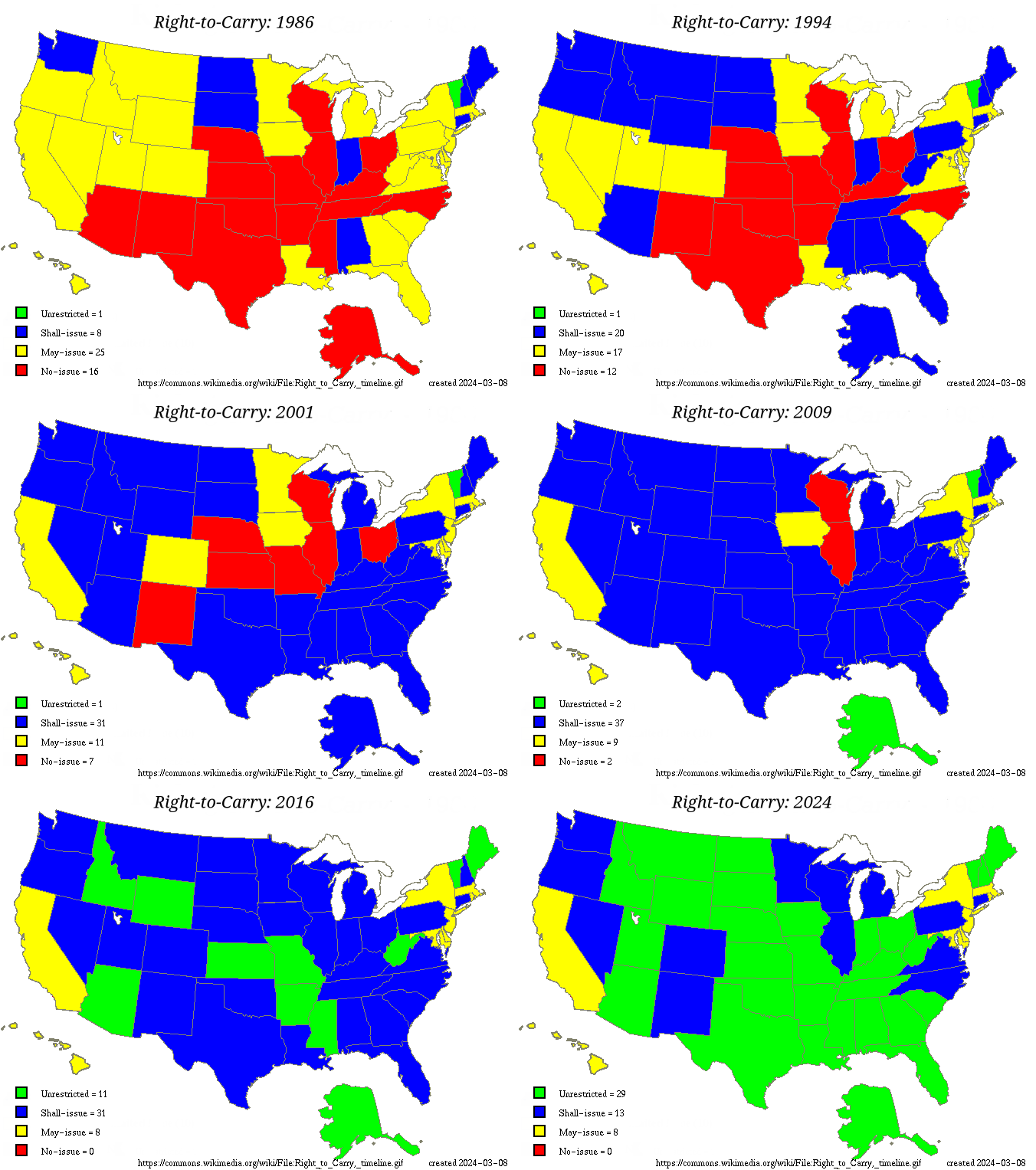
Constitutional carry has made great strides since 2012.  There are 11 states that have permitless or "Consititutional" carry in 2016.  The graphic below is one of the best at illustrating the incremental restoration of the right to bear arms in the United States. Green indicates a permitless or "Constitutional" carry state.


On Oct. 31, 2016, there were more than 95,000 active concealed pistol permits in South Dakota according to the secretary of state's office. The population of South Dakota in 2016  is 844,877.  About 65.4% of the population is 18 or older. That would be 552,550.  People with concealed carry permits are now 17% of the adult population. South Dakota's homicide rate in 2015 was 3.7 per 100,000, unusually high for South Dakota, but well below the national average of 4.9 per 100,000.

The difficulty in passing "Constitutional" carry in South Dakota is getting the bill past Governor Daugaard.  Now that several other states have successfully passed permitless or "Constitutional" carry without ill effects, the bill may have a chance of becoming law.

©2016 by Dean Weingarten: Permission to share is granted when this notice is included.

Link to Gun Watch


Wednesday, November 23, 2016

FL: Clerk Shoots, Kills, Robber, Stops Crime Spree


A gas station clerk shot and killed a suspected serial robber during a Saturday evening holdup in south Tallahassee.

Matthew Brown, a 20-year-old connected to several recent Leon County robberies, was shot and killed at the Sunoco gas station at the corner of Woodville Highway and Gaile Avenue.
More Here

CA: More on Christiansen Shooting


After a two week long trial in Solano County Superior Court, a man facing a murder charge in a Vallejo woman’s death was found not guilty last Thursday by a jury and has now been released from custody after more than two years in county jail.

Michael David Wilson, 49, was accused in the shooting death of 57-year-old Lillie Mae Christiansen, who was shot and killed in July 2014 on the front porch of her friend’s apartment along Mare Island Way in Vallejo. Wilson’s attorney argued that her client acted in self defense and that proved to be enough to sway the jury in favor of the man’s innocence. Wilson was released from Solano County Jail on Thursday following his acquittal.
More Here

AL: Armed Man Shoots, Kills Home Invader at 3 a.m.


FLORENCE, AL (WAFF) -

A home invasion in Florence left the suspect dead early Tuesday.

Florence police say the homeowner shot and killed the suspect, identified as James Devaughn Demoss, 26, of Hanceville.
More Here

OH: Woman Shoots Intruder, Investigation Ongoing


The homeowner, Yalanda Whipple, told police she was in her bedroom when she heard her two children cry out with alarm.

Whipple says she grabbed a gun from under her pillow, and went to the kitchen where she was confronted by a man dressed in black. She then opened fire.
More Here

IN: Domestic Defense, Father Shoots Son to Protect Wife


Investigators say Matthew Uloth was attacking his mother when his father Jon Uloth shot him.

When Deputies arrived, they say Matthew punched a Deputy in the jaw.

Authorities do not expect to file charges against the father at this time.
More  Here

Wisconsin CCW Permit Holders Made a Difference in The Trump Election


Wisconsin was one of the last states to create a permit system for legal concealed carry of weapons.  Permits were first issued in November, 2011. Five years later, 319,069 Wisconsin residents had permits.

To obtain a permit, the applicant had to be 21 years old or older, a legal Wisconsin resident, and not convicted of any felonies or misdemeanor acts of domestic violence.

People who go to the trouble to obtain a permit are serious about their Second Amendment rights. In Wisconsin, probably half are Democrats and Independents. CCW permit holders are, as a group, some of the most law abiding people in America.

My experience as a concealed carry instructor showed me that these people are ultra responsible. They show up early. They offer to help out. They offer to clean up. I never had a problem with bad checks, in fifteen years.

My experience was that most are not NRA members.  Most are not hunters. Most are gun owners. A significant number are veterans or have experience with law enforcement. They tend to be older, experienced, people. About 20 percent are women.

These people are voters, and they vote. I believe they vote in very large numbers, probably in excess of 80 percent.

The 2016 general election in Wisconsin was down a bit from 2012.  There were 3.068 million votes cast for presidential candidates in 2012.  The 2016 election had 2.944 million votes cast, down about four percent.

The difference between Donald Trump and Hillary Clinton in Wisconsin was 27,257 votes. That is less than 9% of the concealed carry permit holders in the state. In 2016, Donald Trump actively courted Second Amendment supporters.  He actively courted concealed carry permit holders.  He bragged about having a concealed carry permit.  He promised that a priority of his administration would be to pass national concealed carry reciprocity, something desired by the vast majority of CCW permit holders.

In contrast, Hillary Clinton made "common sense" gun control a major plank in her platform.  Her euphemism might have gotten a pass from a majority of people who do not own guns. It would not have gotten a pass with informed gun owners, which, includes, almost be definition, people who have a concealed carry permit.

Support for the Second Amendment was not a pivotal issue in the 2012 election.  Most Second Amendment supporters were not enthusiastic about Mitt Romney. President Obama did not push for more gun control with any enthusiasm, until after the election.

Wisconsin only had one year of its shall issue concealed carry program in effect by election night, 2012.  By election night 2016, it had over 319,000 concealed carry permit holders.

They made a difference.  Was it enough to swing the election?  It is impossible to know.  But when Democrats explicitly endorse gun control, they lose, and they lose bigly (big league).

Donald Trump pulled off the biggest upset of presidential politics since Truman. Part of his campaign was to actively pursue Second Amendment supporters.

©2016 by Dean Weingarten: Permission to share is granted when this notice is included.

Link to Gun Watch

DoD Contingency for a President Trump: Directive 5210.56


The U.S. military makes contingency plans for a great many possibilities.  It appears that the DoD has a contingency plan in place for a Trump presidency.  Donald Trump has said he will eliminate gun free zones in the military and at recruitment centers on day one of his presidency.

On November 18th, the Department of Defense released DoD Directive 5201.56.  Deputy Secretary of Defense, Robert O. Work, issued the directive on Arming and the Use of Force, that superficially does away with "Gun Free Zones". It allows commanders at the O-5 level and above to grant people the authority to carry private defensive weapons. 

O-5 is a Lieutenant Colonel (LTC) for the Army, Air Force, and Marines; Commander (CDR) for the Navy and Coast Guard. Not all O-5 officers have the authority; only commanders of units, installations or other organizations do. A military commander is a specific position. Not all officers are commanders. An officer who takes a command position has many special responsibilities and privileges. They stay with the position when another officer takes his place.

The directive is highly restrictive, but it allows for authorizeed DoD personnel to carry personal, privately owned defensive weapons. From dtic.mil:
4.1. GENERAL.
This section provides guidance for determining the eligibility of DoD personnel to carry privately owned firearms on DoD property for personal protection when it is not related to the performance of official duties. This section also provides requirements for individual training, transport, safeguarding, and storage of privately owned firearms that the arming authority must consider when determining whether to permit an individual to carry a privately owned firearm on DoD property.
Here are some highlights of the directive.  There are many restrictions.  There are so many, the directive is almost, but not quite useless.

Each permit holder must be individually approved by the commander involved.  That takes a lot of the commander's valuable time. There are plenty of reasons for commanders to turn down requests en masse, and no incentives given to commanders to approve requests.

The first restriction does much to gut any effective numbers of personnel carrying defensive weapons. It is unlikely that there will be many DoD personnel that will not routinely enter federal buildings. It requires that the Commander determine, after consultation with legal counsel, that an exception under 930(d) of Title 18, U.S.C. applies. From the directive:
a. May grant permission to DoD personnel requesting to carry a privately owned firearm (concealed or open carry) on DoD property for a personal protection purpose not related to performance of an official duty or status. Permissions granted under this section do not apply to carrying a firearm within federal buildings unless the arming authority specifically determines, after consultation with servicing legal counsel and in accordance with applicable DoD policy, that an appropriate exception under Section 930(d) of Title 18, U.S.C. applies.
 Here is 930(d) of Title 18, U.S.C.:
(d) Subsection (a) shall not apply to—

(1) the lawful performance of official duties by an officer, agent, or employee of the United States, a State, or a political subdivision thereof, who is authorized by law to engage in or supervise the prevention, detection, investigation, or prosecution of any violation of law; 
(2) the possession of a firearm or other dangerous weapon by a Federal official or a member of the Armed Forces if such possession is authorized by law; or
(3) the lawful carrying of firearms or other dangerous weapons in a Federal facility incident to hunting or other lawful purposes.
Commanders are caught in a sort of legal bind here.  They are being required to have legal counsel tell them that one of the three exceptions applies. But the directive itself could easily be interpreted to suffice for exceptions (2) and (3), especially if the person applying has a concealed carry permit.

Carrying a weapon for defense of self and others, and especially with a permit, is a lawful purpose in all U.S. territory.  Carrying a weapon after being authorized to do so by a U.S. military commander, is also a lawful purpose.

The directive could have stated that the directive itself meets exceptions (2) and (3), thus taking the burden from individual commanders.

Some other restrictions:
  • Personnel authorized must be 21 years of age or older
  • Personnel not subject to *any* past or pending personnel action
  • When permitted to carry concealed, the firearm must be completely concealed, and not interfere with normal duties
  • May not carry while under the influence of alcohol or other intoxicants 
The directive can be significantly improved.

The finding of lawful exceptions to  930(d) of Title 18, U.S.C. should be included in the directive, relieving individual commanders of that burden.

Commanders should be given incentives to authorize defensive carry.  Such an incentive might be:
If an applicant who has a valid concealed carry permit is refused by the authorizing authority, a written explanation of the reason for refusal shall be given to the applicant.  Applicants that are refused may appeal the refusal to the Inspector General of the organization.

This directive was put into effect 10 days after the election of Donald Trump. That indicates the Department of Defense takes President elect Trump's (and future Commander in Chief) promises seriously.  If you want a policy done on your terms, one of the most effective ways to obtain it is to present it as already accomplished.

President Trump will be well informed of such tactics.  I expect he will make appropriate improvements.

©2016 by Dean Weingarten: Permission to share is granted when this notice and link are included.

Link to Gun Watch


GA: Employee Uses Tactical Judgment, Shoots Armed Robber


Image from 11alive.com

On November 21, 2016, in Atlanta, Georgia, an armed robber attempted to victimize a Dollar store. Attempted is the operative word. The suspect did not succeed. He was wounded twice for his efforts, then he was arrested. He is lucky to have survived. From 11alive.com:
Atlanta Police say the man walked into the store around 9:55 p.m., pulled a gun and demanded the contents of the store’s cash register.

As the robber was leaving the store with the cash register itself, an Atlanta Police spokesman said one of the store’s employees pulled a personal handgun and shot the suspect in the hand and thigh. Police then arrived on the scene and took the suspect into custody without any incident.
It appears that the suspect never fired a shot. This was, in part, because of good tactical judgment on the part of the defender who shot him. A robber who displays a gun does not cease being a threat because he is walking away. A deadly shot can be fired in a fraction of a second.

Defenders should be thinking about when to act in a defensive situation. In some situations, there are few choices. In others, the choices are abundant. If a criminal is attempting to gain compliance, the possibility of a an advantageous time or circumstance is high.

It is difficult for criminals to keep focused on all possible threats at all times.  Their attention may be diverted by an opening door.  They may allow an unarmed accomplice to intervene between them and their victim. Even a glance in another direction is enough to allow a practiced individual to draw and fire.

It is not uncommon for a suspect to focus their attention on their main object: the loot.  Some have put down their guns to better grab the loot.

In the Dollar store in Atlanta, the defender waited until the suspects hands were full with the cash register.  This did not stop the suspect from being a threat; but it made his response slow and ineffective.

Each situation will be different.  Consider your options.  If you decide to make a move, time it to your advantage. Thinking through possibilities before a situation occurs, playing what-if games, will give you a number of pre-considered options and make your response faster and more effective.

©2016 by Dean Weingarten: Permission to share is granted when this notice and link are included.

Link to Gun Watch

Tuesday, November 22, 2016

PA: Governor Wolf Signs Hunting Reform for Semi-Autos, Air Guns


A number of states have unusual rules about what may be used for hunting and what may not. Pennsylvania had a law that forbid hunting with semi-automatic rifles and pistols.  They did not forbid hunting with semi-auto shotguns.  The hunter shown in the image from the Game Commission web site is using a semi-auto shotgun, probably to hunt deer, as she is wearing hunter orange and the shotgun has sights on it. This inconsistency helped in moving the reform forward.

Laws are harder to reform than rules promulgated in hunting regulations.  The Pennsylvania government changed this law to allow increasingly popular semi-auto rifles to be used for hunting. The law also removes the ban on using air guns for hunting. From abc27.com:
HARRISBURG, Pa. (WHTM) – Gov. Tom Wolf has signed legislation that removes a ban on hunting with semi-automatic rifles.

Act 168 of 2016, formerly House Bill 263, also removes the ban on air- and gas-powered rifles.
Here is the wording of the new law, as shown in the HB 263.  From state.pa.us:  
§ 2308. Unlawful devices and methods.

(a) General rule.--Except as otherwise provided in this title, it is unlawful for any person to hunt or aid, abet, assist or conspire to hunt any game or wildlife through the use of:


* * *
(2) A semiautomatic rifle or pistol, except as set forth in subsection (b.1).

* * *

[(5) Any device operated by air, chemical or gas cylinder by which a projectile of any size or kind can be discharged or propelled.]

* * *


(b.1) Additional exception.--A semiautomatic rifle may be used to hunt game in accordance with regulations promulgated by the commission.
Note that the devices will be subject to rules created by the Pennsylvania Game Commission. It is too late in the year for a change this hunting season. I expect the Game Commission will have a rule change for next year.

They have many states to chose from if they wish to study examples that have worked.  In my experience, most other states allow hunting with semi-auto rifles and air guns.  Guns used for hunting tend to follow the pattern used in the military. People who served become familiar with the firearm they used, and are willing to switch to the "new fangled" device.  The previous generation tends to keep what they are familiar with. 

An exception is full auto firearms. Most states have bans on hunting with machine guns. Full auto firearms are highly regulated. Most sport hunters consider them an unsporting advantage.

Some hunting has been done with them.  I have read that Saddam Hussein hunted rare antelope with machine guns from helicopters.  Full auto firearms have been used for pest control. I recall an article where an intrepid rancher in Alaska fitted a BAR to a Cessna to rid his ranch of troublesome bears. Not sporting; but effective.

Many poachers in Africa use AK 47 rifles because that is what they have. Full auto is seldom used because ammunition can be difficult to come by.

Some states regulate magazine capacity.  Arizona removed its magazine capacity restriction in 2012.

The Pennsylvania government is merely catching up with the culture with this reform.

©2016 by Dean Weingarten: Permission to share is granted when this notice is included.

Link to Gun Watch


ME: .22 Beats Knife, Robbery Suspect Wounded


Police say two men with a knife tried to rob a 27-year-old man, but the victim defended himself with a .22 caliber handgun.

The man thought he did not hit anyone, but an hour after the incident, police say a man who ran from the scene went to the hospital with a gunshot wound to his shoulder.
More Here

OH: Gunfight, Clerk Wounded, Robber Driven off


The suspect has been described as a black male, about 5-foot-6, 140 to 160 pounds, wearing a black hoodie, dark-colored jeans, white gloves and possibly a surgical mask.

The suspect fired one or two rounds, the report says. The clerk fired several shots back at the suspect; the suspect ran out of the store toward Wyoming Street.

More Here

OK: Armed Woman Wounds Intruder

TULSA, Oklahoma -

Tulsa Police said a woman shot a man when he went inside her apartment Saturday night.

Detectives said the woman was on the phone with 911 when she shot the man after he broke into her apartment at the Comanche Park Apartments near 36th Street North and Peoria.


More Here

Using Amnesty to Roll Back Second Amendment Infringements


A little known law, passed concurrently with the Gun Control Act of 1968, offers the Trump administration a powerful lever. That lever can be used to roll back infringements on the Second Amendment that exist in the National Firearms Act of 1934.

The National Firearms Act (NFA) is an ill-conceived omnibus gun control legislation passed in 1934. It was poorly written by an ascendant Franklin Roosevelt administration. It was designed to outlaw the possession of handguns through draconian taxes and regulation. The tax stamp for a single item was equivalent to a years income for a day laborer. Thrown in the mix were machine guns (to add some pizazz, they were not a real problem), silencers (for no known reason), and sawed off rifles and shotguns (because it made no sense to outlaw handguns, when anyone could make a handgun from a rifle or shotgun with a hack saw and 15 minutes).

Outlawing handguns was a bridge too far for Congress.  They were taken out of the bill.  What was left was passed as a sop to Roosevelt. After all, it only applied to machine guns, silencers, and short barreled rifles and shotguns that crossed state lines. Few people owned or used those items anyway.  Even fewer took them across state lines.

Not many people paid attention to the law.  There was no provision for people who failed to register their items during the initial grace period to register them afterward. A few registrations trickled in during the following decades under lenient Treasury department tax policy.  The law become a bigger problem with the Supreme Court decision Wickard v. Filburn in 1942. In that decision, the court expanded federal law to apply to items that did not cross state lines.

When the Gun Control Act of 1968 was passed, the Congress concurrently passed a bill to allow an amnesty for people who had unregistered NFA items. No fingerprints or tax was required.  Fill out a paper form and send it in, and your NFA item was registered.  The initial amnesty was for 30 days in 1968, from October 2nd to November 1st. The law contained a provision for further amnesties at the discretion of the Secretary of the Treasury. They only needed to be announced beforehand in the Federal Register. From PUBLIC LAW 90-619-OCT. 22, 1968, found on page 1236 of United States Statutes at Large Volume 82.djvu/1278:

(d) The Secretary of the Treasury, after publication in the Federal Register of his intention to do so, is authorized to establish such periods of amnesty, not to exceed ninety days in the case of any single period, and immunity from liability during any such period, as the Secretary determines will contribute to the purposes of this title. TITLE III — AMENDMENTS TO TITLE VII O F THE OMNIB U S C R I M E CONTROL A N D S A F E S T R E E T S ACT O F 1968
I do not believe this statute has ever been repealed or superseded. It appears to be effective law.  In 1968, there was an expectation that amnesties would be a common, regular occurrence to bring unregistered NFA items into the legal fold.

Many people believe the NFA should be repealed, as an obvious infringement on the Second Amendment.  That may be a step too far for the Trump administration for the first term. But the NFA is terribly flawed legislation and is ripe for reform.

It is insane to regulate silencers (gun mufflers) at levels far more strict than Europe.  In New Zealand any child with the money can walk into a hardware store and buy a silencer for $20.

It is insane to regulate short barreled rifles and shotguns more strictly than handguns.  If the law is going to differentiate between long guns and handguns, a simple size difference would make sense. Anything over 26 inches is regulated as a long gun. Anything less than 26 inches is a regulated as a handgun. No separate draconian taxes and regulations for a shotgun with a 17 inch barrel.

In 1986, in a nasty legislative maneuver, the Democrats managed to place a ban on the future production of strictly regulated machine guns for civilian ownership. It was added as an amendment to the 1986 Gun Owner Protection Act. This punished legal owners of machine guns, who were already highly regulated by the NFA. Why? Because no citizen had murdered anyone with a legally owned machine gun in the 54 years of the NFA!  There had been no problems. Therefore future ownership of highly regulated machine guns had to be banned!

All three of these provisions are ripe for reform.

The Hearing Protection Act changes the regulation of silencers from being treated the same as machine guns to being treated like rifles or shotguns.

Short barreled rifles or shotguns should be eliminated as a special class. Instead, handguns should be re-defined as any firearm that is designed to be fired in a configuration shorter than 26 inches. 26 inches is the current standard for short barreled rifles and shotguns.

The ban on highly regulated citizen ownership of machine guns made after 1986 should be repealed.

The Amnesty law offers the lever to accomplish these reforms.

If the Democrats want to filibuster the Hearing Protection act, offer a 90 day amnesty on the registration of silencers for the NFA.  No tax, no fingerprints, just fill out a form and send it in. If the Democrats refuse to relent, rinse, and repeat. Pound the new media and twitter with the insanity of the current law. 100 million gun owners will appreciate Donald Trump as a defender of the Second Amendment.

The same thing can be done for reform of the insane short barreled rifle and shotgun provisions.

The same can be done for the repeal of the 1986 ban on manufacture or licensing of machine guns under the NFA.

These tactics can be used sequentially or concurrently, whichever is considered wiser.  The NFA infringements cannot be logically defended.  They will be emotionally attacked. But the power of the establishment media to define and control the debate has been broken.

Trump supporters are Second Amendment supporters.  They work. They organize. They vote. Their support is committed. It is deep and strong. Most of them voted for Trump, but some were uncertain and hesitant because of statements President elect Trump made 15 years ago. These reforms will make President Trump a hero to Second Amendment supporters.

Opponents of these reforms are billionaires who want to disarm the public. They have deep pockets, but their popular support is shallow and weak, propped up by their billions and the establishment media. They will never support a Trump presidency, no matter what.

Amnesty is the lever than can overcome the anti-Second Amendment opponents.  Those in the middle will see the obvious benefits to making the law more rational. What Democrat can be against amnesty, that brings formerly illegal items into the regulated fold, under existing law?

©2016 by Dean Weingarten: Permission to share is granted when this notice and link are included.

Link to Gun Watch


Monday, November 21, 2016

TX: Armed Husband Shoots Intruder

About 3:30 a.m. Saturday, a homeowner heard a knock on the front door of her house in the 6700 block of Labonte Drive, Pace said. The homeowner looked out the window and did not recognize the stranger at the door. When she went to tell her husband about it, the couple heard the man come in through the back door. The husband shot the intruder in the torso.

More Here

CO: Guard Shoots Armed Robbery Suspect


A security guard shot and wounded an armed robber during a holdup Friday night at an off-track betting parlor in northeast Colorado Springs, Colorado Springs police said.

More Here

Followup KY: Accompice Faces Murder Charges


LOUISVILLE, Ky. (WHAS11) – A suspect in an attempted break-in is now facing murder after police say the homeowner shot and killed the would-be burglar’s accomplice.

Aaron McDuffie, 23, faces several charges including murder and burglary.

More Here

OH: Burglary Suspect Shot in Leg, Runs


Because of recent burglaries at the 295 Park Avenue West convenience store, Coontz said, the business owner had asked two people to guard the business overnight. Those two people were in the building at the time. An altercation followed the intrusion, and one of the two people guarding the building shot Schneurer.

After Schneurer was shot, she began to run, Coontz said. A 48-year-old male witness told police he saw Schneurer lying on the ground with a gunshot wound and drove her to the hospital, according to the police report. The injuries were not life-threatening.
More Here

Thoughts on a Post Presidency Barack Obama


President Barack Obama has been hinting, quite strongly, that he will be active in politics after he leaves the Presidency.  He is relatively young, so he can be expected to be around for two to three decades. In spite of most ex-presidents staying out of the political sphere, with some exceptions by Presidents Carter and Clinton, this activity will be quite unusual.  But I do not expect it to be a bad thing for the Republic.  Here is why:

The Democrats have built him into a cult of personality that makes Bill Clinton look pale (pun intended).  The party will not be able to resist his takeover, now that the Clinton machine has been discredited with the defeat of Hillary Clinton.


The Democrat party will move even further to the left under Barack.  His appeal will only be reduced as he no longer has the full power and status of the Presidency.  The establishment media will gradually grow tired of his harangues, that will not be tempered by a bevy of advisers and speechwriters, and kept on track by teleprompters.  Barack is already famous for gaffes when he goes impromptu, and he will be doing that much more frequently as a private party.

Barack will take the Democrat party down to a minority party status.


The establishment media has lost control of the narrative with the election of Donald Trump.  The technological arrow has been pointing in this direction for two decades now, and there is no reason to believe it will reverse anytime soon.

Barack has never been one to easily take outside counsel.  He will not let the Democrat part move toward the center. This will continue for decades.

No one will be able to say no to the affirmative action president, and his false assumptions about reality will drive the Democrats to further defeats.

Good luck, as head of the Democrat Party, Mr. President!

©2016 by Dean Weingarten: Permission to share is granted when this notice is included.

Link to Gun Watch

Successful Deer Hunt with Northern Wisconsin Long Shot


Deer hunting in Northern Wisconsin seldom requires shot of more than a hundred yards. That is because most of the hunting is in dense forests or in woodlots where visibility is restricted.  The occasional long shot is available, but they are unusual. This eight point "basket buck" was taken yesterday, on opening day 19 November, 2016.


The Namekagon river offers one of the few opportunities for long shots in the area.  Most deer are harvested at a hundred yards or less.  The buck was crossing the river 275 yards upstream when it was shot. In this unusual case, the deer floated down to the waiting hunter, who did not have to drag it very far.

Two inches of fluffy snow made for much better visibility for hunters.  It did not play a part in this shot, as the dark river did not provide much contrast to the deer.  The hunter in this case is an accomplished and expert shot who had the equipment and skill to make a one shot, one kill performance.

Another advantage of fresh snow for deer hunters is the ease of tracking deer.  A wounded animal can be followed up in a timely manner. Blood shows up very well on snow, and aids in keeping the correct track.

Tracking deer who are not wounded is also productive. Hunters who stay on a trail may get a shot at a deer. It is more likely that they will move the animal past a hunter on a stand, who will have a better chance.

Such combination tactics are a long time favorite of deer hunters in the North Woods.

Hunters in the field likely jumped this buck, who then decided to cross the river, exposing himself to the expert rifle shot on the island downstream.


©2016 by Dean Weingarten: Permission to share is granted when this notice is included.

Link to Gun Watch


FL: More on CCW Permit Holder Saving Police Officer


A note from Sheriff Mike Scott:

Earlier this week, two heroes met on I-75 and while they had never met before, one would save the others life. I was at the hospital when the ambulance arrived, the rear doors opened, and my Deputy Dean Bardes was unloaded on a stretcher. Bloody from a vicious attack by a driver Bardes had stopped for endangering the lives of other innocent citizens in our community, the Medics wheeled him into a treatment room. Joined by others from our team, I was there when his wife and family arrived with fear and concern for their loved one as the E.R. team worked on him. Ironically, this was the first day in a while that Deputy Bardes was alone on patrol because as a Field Training Officer, he typically has a recruit riding with him to learn the business. A business that has seen an increasingly alarming rise in attacks and killings perpetrated on cops. A business that has fallen victim to false narratives like Ferguson where the good guys have been painted as the bad guys by a vocal minority that refuses to allow facts and evidence to get in their way. A business that is the last line of defense between good and evil.


On behalf of the men and women of the LCSO, I thank Deputy Dean Bardes for his bravery and pray for a full recovery. I thank the E.R. staff and E.M.S. for their immediate attention to Dean, and I thank the many witnesses to this event who stopped to assist our Detectives. I thank my good friends at “Shoot Straight” who realized that the hero’s gun was taken as evidence and immediately gave him a brand new firearm. Above all, I thank the hero that recognized the imminent threat, rushed to Deputy Bardes’ aid, and ultimately stopped that threat. In a day and age where race is a near instant focus for media and other pundits in police incidents, the fact is that this hero happens to be a man of color who stopped another man of color from further harming or killing a white cop; thereby reminding us that black lives matter, blue lives matter, and indeed all life matters. We at your Sheriff’s Office remain proud to serve and focused on the mission.

Mike

Source Facebook Lee County Sheriff's Office

TX: Concealed Permit Holder Shoots Man Running and Gunning


According to police, some family members leaving a concert after 9 p.m. found their car was burglarized near the downtown intersection of Bonham and 4th Street. While they waited for police to arrive, they heard gunfire and saw a man with a gun running toward them firing more shots. One of the concert-goers pulled out his own gun and ordered the other man to drop his weapon. When the suspect did not comply, the man fired one shot, hitting the suspect in the arm. Investigators say the concert-goer does have a concealed handgun license and will likely not face any charges since he claimed his family felt threatened.
More Here

Sunday, November 20, 2016

KY: Armed Mother Shoots, Kills Home Invader


The son of the homeowner described what happened between his mother and the attempted burglars.

"They busted the back window out, and that's when she stepped out of the hallway and let one shot go and hit somebody, and obviously she got him," said Bruce Haddix, whose mother shot the man.

Even though the homeowner is OK, Haddix says the whole incident has her shaken. He added that he's thankful he had his mom learn how to shoot a gun and purchase one about a year and a half ago, because the outcome could have been much different here Friday.
More Here

OR: Man Displays Gun, Stops Home Invasion Attempt


It seemed to me like it was probably four of them. They were coming and going and it was hard to differentiate them because they were dressed in black with masks…They come right at daylight. It was still somewhat dark when they got here. My driveway alert kept going off. I went to my window…I was on the top floor…They were all dressed in black with black [ski] masks. …I saw right away that one of them had a gun. It wasn’t until later that I saw the others [had guns].

More Here

TN: Armed man Shoots Robbery suspect


Some guests said the shooting was part of an attempted robbery, but the target instead pulled a weapon and shot the would-be robber. The man died at the scene.

Police would not confirm a robbery attempt but said they had a person of interest in the case, and there was no suspect on the loose.

More Here

Study on "Stand Your Ground" Seriously Flawed


This week, the Journal of the American Medical Association’s (JAMA) online Internal Medicine Network published a “study” by a team of academics in England that purports to analyze “the Impact of Florida’s ‘Stand Your Ground’ Self-defense Law on Homicide and Suicide by Firearm,” with the authors concluding, “implementation of Florida’s stand your ground self-defense law was associated with a significant increase in homicides and homicides by firearm but no change in rates of suicide or suicide by firearm.” View Related Articles

You’d think with a conclusion like that, the study found that the Florida law actually had a negative impact on public safety. But you’d be wrong. Rather, this article stands as but another example how anti-gun scholars continue to perpetuate bad science in order to push their agenda with improper methodology, misleading claims, and a purposeful failure to follow base statistical protocols in conducting an analysis.

An incisive rebuttal to the study published in National Review points out that even taken at face value, the findings have virtually no significance for public policy. Indeed, the JAMA authors admit near the end of their paper that “[o]ur study examined the effect of the Florida law on homicide and homicide by firearm, not on crime and public safety.”

More Here

Kenya Gun Destruction, 2016


On November 16, 2016, the government of Kenya destroyed 5,250 guns.  The method used was fire. It isn't that guns are not valued in Kenya.  Villages in Kenya are being raided for slaves by al Shabaab, an African affiliate of ISIS. They have sworn allegiance to the new Caliphate in the middle east. Kenya has allied with other govenments to fight them. Al Shabaab loudly proclaims its Islamic right to raid, kill, and enslave unbelievers.

But the Kenya government does not trust the villagers with any guns, even single shot muzzle-loaders, let along AK47 rifles. From africanews.com:
Somalia’s insurgent group al Shabaab, which seeks to overthrow the country’s Western-backed government and impose a strict version of sharia – Islamic law, has carried out regular assaults in neighboring Kenya in recent years as retaliation for Kenya contributing troops to an African Union peacekeeping force in Somalia.

Kenya last burnt a similar collection of illegal weapons in 2003, 2005 and 2010.

Africa has been prone to small arms proliferation which has in turn resulted in political and social unrests in most parts of the continent. Reinforcing existing small arms treaties at the national, subregional and the continental levels are seen as important to maintain stability and peace in Africa.

The African Union says there is the need for a concerted effort to combat trade in illicit small arms and light weapons which continue to cause untold suffering and pain, threatening the peace and security of the region.
Kenya is not a rich nation. There is tremendous poverty in the rural villages. It is hard to believe that the rifles, shotguns and a few pistols could not have brought at least $100 each.  That would have been a half a million dollars.

Better yet, distribute the guns to village militias to defend against Al Shabaab.  Even a few arms could result in significant resistance. That is not an option when the government is a kleptocracy riddled by tribal loyalties.

One village was started by women who were rape victims.  It only took one man with a gun to destroy it.  The village was helpless against him.

In the pictures of the stacked firearms, I see a lot of AK47s or AKMs, a fair number of SKS rifles, Enfield MKIII and IVs, M-16s, G3s, a smattering of air rifles, sporting bolt guns, and decent double barreled shotguns. There is a Martini-Henry in full military regalia, an RPD, an RPK, a few RPG grenade launchers.  There are a couple of single barreled shotguns.


In the picture above, you can see a Webley MKIII nestled in between RPG launchers.  Just to the left, is a homemade pistol.  In another place there was a M-2 .50 cal machine gun.  I saw one possible sub-machine gun. It looked like an American "Grease Gun", the M3.  There was a Mauser 98, and what appeared to be a sporterized Arisaka M38 from WWII!

It is sad to see such valuable resources destroyed when they could be put to good purposes.  One reform that could help would be to allow personal importation into the United States. A limit of 3 firearms acquired overseas sounds reasonable. That was the policy until the middle 1960's.  There was no duty or special license required for such personal importation.  It would give governments overseas a way to get rid of some of their excess firearms, and make a profit at the same time.

It may not be a high priority for the Trump administration in the first hundred days.  It is a small reform that would be appreciated by the Gun Culture.  I considered a visit to the Czech Republic, to look for a nice drilling or double. But I found an import license costly and impractical to obtain.

I would gladly spend a couple of hundred dollars for that Webley, one of the double barreled shotguns, or the Martini-Henry. 

©2016 by Dean Weingarten: Permission to share is granted when this notice is included.

Link to Gun Watch

Chicago Tribune: Obama has been Pro Second Amendment!


Steve Chapman is a writer for the Chicago Tribune. He has often written about gun legislation. He stands out at the Tribune as a voice that recognizes reality more often then most.  His writing and viewpoints have been a reasonable voice crying in the wilderness of Chicago.

Unfortunately, he lives in the fantasy bubble of current Progressivism. It is evident in his recent column excoriating the NRA.  He buys into the leftist propaganda without introspection or examination of facts. It is an opinion column, but opinions should have a basis in reality. From chicagotribune.com:
As a gun owner, recreational shooter, former NRA member and longtime advocate of Second Amendment rights, I like to see cogent criticism of gun control proposals and anti-gun propaganda. But under President Barack Obama, the NRA has occupied itself sowing groundless panic and fighting imaginary villains.

Obama made it plain in his first presidential campaign that gun control was not a hill he was willing to die on. He assured gun owners, "I believe in the Second Amendment. I believe in people's lawful right to bear arms. I will not take your shotgun away. I will not take your rifle away. I won't take your handgun away."
  
He fails to point out that President Obama is famous for his prevarications. Why would anyone believe President Obama's promises about future actions any more than his promises about "keeping your doctor, if you want to", "keeping your plan if you like it" or the famous "saving $2,500 a year on your insurance premiums"?  Should we forget the "red line" in Syria? Yes, bringing in Second Amendment supporters was important for him to win the White House. Gee.  He lied.

Chapman admits that President Obama pushed for ending the manufacturing and sale of "assault weapons".  That happens to include the most popular rifle in the country.  Chapman admits that President Obama pushed to ban magazines that hold more than 10 rounds of ammunition.  That would be hundreds of millions of the most popular magazines in the country, for scores of millions of rifles and pistols. Chapman admits that President Obama pushed extraordinarily hard for "universal background checks".  Chapman does not mention that he only pushed for the bill that required that firearm serial numbers and personal information be permanently recorded on federal forms. A bill for universal background checks that protected personal privacy, to prevent universal gun registration, was killed by the President's allies in Congress.

Chapman lumps all these actions as insignificant.  He uses this phrase:
"These changes would have a minimal impact on law-abiding gun owners."
That is Steve Chapman's opinion. Millions of American gun owners beg to differ.

Chapman points out that President Obama signed bills that restored the right to bear arms in national parks, forbade the EPA to ban lead bullets, and prevented Amtrack from banning the transport of unloaded guns on its trains. He conveniently fails to mention that all of those measures were included as unwelcome riders on omnibus bills that President Obama desperately wanted to sign.

President Obama never championed those measures, never lobbied for their inclusion, never supported them at all.  Then, after they became law, he has tried to take credit for them.

Champman conveniently fails to mention President Obama's long held antipathy toward general gun ownership, most clearly stated in his remarks to John Lott at the University of Chicago.

Chapman is delusional here.  He lives in the liberal fantasy world of the establishment media and their fake news bubble.
 

©2016 by Dean Weingarten: Permission to share is granted when this notice is included.

Link to Gun Watch

Saturday, November 19, 2016

TX: Gunfight in Home's Fourth Home Invasion


CORPUS CHRISTI -

Three men break into a home on Deer Creek Drive. Inside is a woman and an adult male. The adult male is armed and a gunfight starts inside. Eventually the gunshots end and the three men flee the home. There are no injuries but it's the fourth time since 2015 the house has been targeted for a home invasion.

More Here

CA: Man Charged for Inadvertent Discharge during Confrontation with Teen


Brandt demanded the teen leave, and when the boy refused, he retrieved a Glock 30 .45-caliber sub-compact semiautomatic pistol, Cramer said. The teen again refused to leave, and they engaged in a “shoving match” during which Brandt inadvertently fired his gun into the air, according to police.
More Here

AL: Armed Homeowner Drives off Intruder


Officers tell ABC 33/40, someone tried to break into a home around 2:30 a.m. Wednesday on 4th Avenue North.

The homeowner shot at them.
More Here

AZ: Teen Burglar shot Multiple Times


A teenage burglar was shot by a homeowner after breaking into a Buckeye residence Wednesday, according to the Maricopa County Sheriff's Office.

More Here

TN: Homeowner, 1 of 3 Invaders Shot, Critically Wounded


Investigators say the victim told them he got a knock on his door, from a man who wanted to talk to him about an accident a week before. The victim said they began arguing, when two other men came up and shoved their way into the home.

The victim told officers the men were all armed and began making threats and taking items from the home.

Police say the victim and the three men started shooting at each other. The victim and one of the suspects were hit. They don’t know if the other two suspects were struck as they ran away.
More Here

NJ: Man Attempts to Surprise Woman, is Shot, Killed

A lack of communication, with horrific consequences.

She opened her bedroom door, and saw the shadow of a person in the dark on the stairs, and fired one gunshot, police say.

"He's out of town and she thinks he's far away and then somebody's coming in her house. You can't blame her in a way, it's just an awful tragedy," said neighbor Ed Bastecki.

"When you do something like that you're thinking it's a burglar, and here it's a friend of yours. You know it's got to be devastating for the person that was shot and the person who did the shooting," said neighbor Tom Fiden.

More Here

Do "Stand your Ground" laws increase deaths?


The academic journal article below says they do. As a retired man, I don't intend to make any attempt to replicate their findings so I am not going to critique their methods of analysis.  I would however like to make two points about the study:

1).  Who were the extra people who died? I think there was a fair chance that it was the bad guys -- home invaders etc.  That was after all the intention of the law. So maybe the situation is cause to break out the champagne!  Unsurprisingly, the study was silent on that question.

2).  Why Florida?  23 States have such laws.  Did the authors pick out Florida because a quick scan of the data showed a result in Florida that they liked?  I wouldn't put it past them given the large current literature about crooked practices in science.  But however we answer that, it is clear that no generalizations from the findings are possible.  Florida could be the odd State out.  We simply do not know.


Evaluating the Impact of Florida’s “Stand Your Ground” Self-defense Law on Homicide and Suicide by Firearm

David K. Humphreys et al.

Abstract

Importance:  In 2005, Florida amended its self-defense laws to provide legal immunity to individuals using lethal force in self-defense. The enactment of “stand your ground” laws in the United States has been controversial and their effect on rates of homicide and homicide by firearm is uncertain.

Objective:  To estimate the impact of Florida’s stand your ground law on rates of homicide and homicide by firearm.

Design, Setting, and Participants:  Using an interrupted time series design, we analyzed monthly rates of homicide and homicide by firearm in Florida between 1999 and 2014. Data were collected from the Wide-ranging Online Data for Epidemiologic Research (WONDER) web portal at the Centers for Disease Control and Prevention. We used seasonally adjusted segmented Poisson regression models to assess whether the onset of the law was associated with changes in the underlying trends for homicide and homicide by firearm in Florida. We also assessed the association using comparison states without stand your ground laws (New York, New Jersey, Ohio, and Virginia) and control outcomes (all suicides and suicides by firearm in Florida). October 1, 2005, the effective date of the law, was used to define homicides before and after the change.

Main Outcomes and Measures:  Monthly rates of homicide, firearm-related homicide, suicide, and suicide by firearm in Florida and the 4 comparison states.

Results:  Prior to the stand your ground law, the mean monthly homicide rate in Florida was 0.49 deaths per 100 000 (mean monthly count, 81.93), and the rate of homicide by firearm was 0.29 deaths per 100 000 (mean monthly count, 49.06). Both rates had an underlying trend of 0.1% decrease per month. After accounting for underlying trends, these results estimate that after the law took effect there was an abrupt and sustained increase in the monthly homicide rate of 24.4% (relative risk [RR], 1.24; 95%CI, 1.16-1.33) and in the rate of homicide by firearm of 31.6% (RR, 1.32; 95% CI, 1.21-1.44). No evidence of change was found in the analyses of comparison states for either homicide (RR, 1.06; 95% CI, 0.98-1.13) or homicide by firearm (RR, 1.08; 95% CI, 0.99-1.17). Furthermore, no changes were observed in control outcomes such as suicide (RR, 0.99; 95% CI, 0.94-1.05) and suicide by firearm (RR, 0.98; 95% CI, 0.91-1.06) in Florida between 2005 and 2014.

Conclusions and Relevance:  The implementation of Florida’s stand your ground self-defense law was associated with a significant increase in homicides and homicides by firearm but no change in rates of suicide or suicide by firearm.

JAMA Intern Med. Published online November 14, 2016. doi:10.1001/jamainternmed.2016.6811

John Lott addresses the Mexican Legislature on Gun Law

On Wednesday, 16 November, 2016, John Lott testified before the Mexican legislature about the benefits of an armed population. He was invited by Senator Jorge Luis Preciado.  A reform of the Mexican gun control laws is getting a serious consideration.  On October 6, Senator Preciado published a policy recommendation to emulate the U.S. Second Amendment. This would not be simple legislation, but a change in the Mexican constitution.

From John Lott:
The last few days have been very exciting with me testifying before the Mexican Senate and House Constitution Committees as they consider changing the Mexican Constitution. Right now Mexicans are only allowed to have small caliber guns and only in their homes. The proposed changes would again allow people to keep their guns with them in their businesses and cars. Right now there is also only one gun store in the entire country and it is located in Mexico City, thus making it impossible for poorer people from the rest of the country to legally own a gun. My testimony was well received and was broadcast live on Mexico's two largest television networks as well as their version of C-SPAN. Over a hundred newspaper articles have been published in Mexico after my presentation. Hopefully in our next email we will have a link to my testimony.
At the CPRC, they have a translation of one of the articles in Melenio, on of the larger national newspapers. From the crimeresearch.org:
“It’s easy to talk about what could go wrong in the arms control debate, but you do not have to guess, there are many experiences in a number of countries that can be considered.

“For example, if it has worked in the United States, why not believe that in Mexico too? Since the system has not worked they may not do so as a federal law, but by states and see how it is resulting. Some states may be allowed to experiment, local laws are enforced, some states have high levels of criminality, it is obvious that the system failed, what can they lose if they give people the opportunity to defend themselves? “He asked.

Lott is a member of the forum invited by Senator Jorge Luis Preciado to analyze the use of weapons, titled “Analysis of the reform initiative to the Federal Law on Firearms and Explosives. In self-defense, “to be held today at the Senate.
The makes the possibility of international reciprocity between Mexico and the United States something to consider. It would be a fitting subject for talks on the North American Free Trade Agreement (NAFTA) reform.


 ©2016 by Dean Weingarten: Permission to share is granted when this notice is included.

Link to Gun Watch

Major Fail at USA Today. No Mention of the Caetano Decision


USA Today has an unsigned editorial today, 17 November, 2016, that shows editorial ignorance, laziness, or stupidity. It could be a combination of all three. Instead of doing original writing, they simply reprint parts of a Massachusetts Supreme Court decision that tries to make the case that stun guns are not covered by the Second Amendment. From usatoday.com:
Finally, neither the legislative ban on stun guns nor our decision affects the defendant’s right to bear arms under the Second Amendment. Barring any cause for disqualification the defendant could have applied for a license to carry a firearm. ...

We acknowledge that stun guns may have value for purposes of self-defense, but because they are not protected by the Second Amendment and because a rational basis exists for their prohibition, the lawfulness of their possession and use is a matter for the legislature.
What is not mentioned, is that the Supreme Court of the United States unanimously struck down their ruling in Caetano v. Massachusetts. From oyez.org:
In a per curiam opinion, the Court held that, although stun guns are unusual in nature and were not common during the enactment of the Second Amendment, they are included in the Second Amendment’s protections. To hold otherwise would be inconsistent with the Supreme Court’s decision in District of Columbia v. Heller, which held that Second Amendment protections extend to arms that were not in existence at the time of the founding.

Justice Samuel A. Alito, Jr. filed a concurring opinion in which he reiterated the importance of access to self-defense and the rights afforded by the Second Amendment. Justice Clarence Thomas joined in the concurring opinion.
The unanimous ruling shows that the Massachusetts Supreme Court was simply wrong in its decision.  So what is the point of reprinting parts of the bad decision by the Massachusetts Supreme Court?  You would, at minimum, expect USA Today to inform its readers that the case had been struck down.

Even the New Jersey AG had to admit that New Jersey's ban on stun guns is unconstitutional, based on the Caetano decision.

Ignorance? Laziness? Stupidity?  All three?  Who knows.  Maybe the writer had a deadline, a hangover, and is suffering from Trump Election Syndrome.

©2016 by Dean Weingarten: Permission to share is granted when this notice is included.

Link to Gun Watch

Friday, November 18, 2016

LA: Domestic? Gunfight in Front of Store


ABBEVILLE, La. (KLFY) – An altercation in front of a convenience store in Abbeville lead to a shooting Tuesday night and friends and family of the owner say he hates what happened, but he had to protect his family.

“He did not have a choice. My brother is very, very remorseful this is a life we value human life,” said Carol Buchannan, the store owner’s sister.

Just before 10:00 Tuesday night, Abbeville Police responded to shots being fired in the 400 block of Martin Luther King Jr. Drive near Pa Paw’s convenience store.

More Here

KY: Domestic Defense? Boyfriend Stabbed, Shoots Known Man Attempting Break-in


The assault happened about 8:30 p.m. Tuesday on Henton Road near West Main Street. A woman told police a known man tried to break into her home. The woman said the man, identified by police as 27-year-old Aylette J. Gibbins, stabbed her boyfriend.

The boyfriend fought back during the disorder, firing a shot at the suspect.

More Here

OH: Armed Clerk Fires at Armed Robber, no one hit


GARFIELD HEIGHTS, Ohio – A Garfield Heights convenience store employee thwarted a robbery by shooting at an armed man, police said.
More Here

TX: Gun Beats Machete in Parking Lot


According to a statement from the SPD, the store clerk told dispatchers that he had just been attacked in the parking lot by a person known to him. The suspect had chased the victim with a machete.

The clerk said he shot at the suspect. The suspect was last seen running on foot in the alley behind the store. A few minutes later a call was received from a resident of an apartment in the 900 block of East Wells requesting an ambulance for a male who had been shot.
More Here

ME: Man Accidently Shoots Woman While Saving Her


HOLLIS, Maine — Police have charged the boyfriend of a Hollis woman with domestic violence and assault, after the woman was shot five times by a man who was trying to save her.

Police said that about 8:30 p.m. Tuesday on River Road, 30-year-old Ryan Giliken assaulted his girlfriend.

A Tale of the Village Gun


My father did not spend a lot of time talking about the hard times in the Depression.  His father had been an avid hunter and trapper, and had passed those skills down to him.  Sometime in the 1930's he had obtained the Village Gun, my name for the old Springfield 84-C .22 bolt gun.  It had been nearly new, with a Weaver straight tube 2 3/4 power 3/4 inch scope when he purchased it for $7.50. Times were hard in the Depression.  Money was hard to come by. Wages for a boy picking rocks in farmer's fields were 50 cents a day.  As a man, my father was paid a dollar a day. It could be those were the wages he used to buy the rifle.

I only heard a few hunting stories about the Village Gun growing up. Most of the hunting stories involved my father's Savage 99, chambered in the classic .300 Savage caliber.  It was his favorite deer rifle.

This is a story of deer hunting with the Village Gun.

My father was a superb woodsman. He was quiet on his feet and taught me some of his skill. I could never gain his proficiency in the woods.  I inherited my mother's eyes.  My father could see things that were invisible to those without 20/15 vision and a lifetime of interpreting the cluttered visual field of the North woods.  He told me "Don't look for a whole deer.  Look for parts of a deer.  You will see an ear, or an eye, or an antler. You might see the straight line of a back, or a tail, or a leg."


Once, while my parents were visiting me and my wife in California, we took a walk through a live oak woods.  He pointed out three deer a hundred yards away, among the trees. I, my wife, and my mother, strained to see the animals. He said "they are going to run any moment". He could tell from long experience of observing deer body language. 30 seconds later, we watched three deer bounding through the trees. I could see them once they started running.

 My father knew the land within a few miles of the farm far better than the proverbial "back of his hand". I doubt that he could tell you about every vein on the back of his hand.  But he could tell you about the spruce grove in the hollow off the logging road, just past the big turn before you top the ridge. I could recognize those places, places where I had been dozens of times.

The country was different in Northern Wisconsin when he was a boy and young man. There were few big trees.  Most of those had been cut during the logging boom from 1880 to 1920.  The Wisconsin North Woods had supplied 80% of the worlds' lumber in some of those years.  The secondary growth was only a few years old. This story happened about 30 miles north of the farm.

He was visiting his in-laws in country even wilder than where I grew up. It wasn't deer hunting season. He had taken the Village Gun in the hopes of getting some meat in the early fall.

He told his father in law that he was going to get a deer. Grandpa Gillis was skeptical. My father walked out the door and into the woods with the Village Gun. In the early afternoon he was carefully, slowly, and quietly slipping through the woods, rifle carried at a high ready, safety on and under his thumb. He was in cedars near a creek.

Then, he saw it.  The front legs and shoulder of a deer.  He was hunting for meat. The rifle came up smoothly and quietly as the safety slipped silently forward and off. The rifle spat. Standard velocity out of a long barreled .22 is not a thunderclap. The deer did not immediately jump. Snap, snap, two more shots entered the ribcage just behind the shoulder, before the doe knew that something was wrong. The deer took off.  Bolt actions can be very fast when you are practiced.

My father was not in a rush.  He knew the deer was dead.  Better to let it lie down and expire, instead of rushing forward and having it run further.

After a minute, he moved forward a few yards, softly, softly. Suddenly there was the deer, peering right at him from 50 feet away.  In the dense cover, he could only see the head. "How are you still on your feet?" he thought. He took another shot, carefully placed just below the line of the eyes, aimed to intersect a line connecting the two ear openings.  A deer's brain is not a large target.  The deer dropped out of his sight.  He continued forward, carefully, slowly, quietly.

There was the deer looking at him again!  He was sure that was a dead deer!  It was a few yards away from where he had last shot it.  Again, only the head was visible.

The Village Gun came to his shoulder one last time.  With the last shot to the brain, the deer dropped dead.  My father was amazed at what had happened. Deer just didn't act like that. That deer should have been dead three times!

My father investigated.  Maybe there was a branch or twig he had not seen, that had deflected a bullet or three.

He looked at the deer he had just killed. It was a good shot, a bullet to the brain, a quick, instant, painless death.  But there was only one hole, one shot, no entry wounds in the chest. He investigated further.  Aha.  A second deer, virtually identical to the first.  Another single bullet to the brain.  No chest wounds.

More investigation revealed the third deer, the first he had shot, a good sized doe. No head wounds on this one.  Only three tightly spaced shots through the lungs. It was an adult doe with two nearly adult offspring.

I am sure none of the meat was wasted.  He field dressed the deer and went back to tell his father in law to hitch up the horses.  He had three deer to bring in.  Grandpa Gillis did not believe him until he saw the deer on the ground.

Shooting multiple animals in dense cover because of mistaken identity is not uncommon, if you spend a fair amount of time in the field.  Roy Chapman Andrews had a similar experience to my father's. It was with Alaskan brown bears on Kodiak Island.

The circumstances were similar. It was a female with two young that were almost ready to go out on their own. The famous explorer, spy, and museum curator shot brown bears with a 6.5x54 Mannlicher Schoenauer.  Like the Village Gun, it was a five shot bolt action. Both men were excellent woodsmen.  Both grew up in Wisconsin.  Andrews was a generation older. I am sure they would have enjoyed each others company.

Maybe the Village Gun has a few more tales. I will ask my brother if he recalls any.

©2016 by Dean Weingarten: Permission to share is granted when this notice is included.
Link to Gun Watch