
©2016 by Dean Weingarten: Permission to share is granted when this notice and link are included.
Link to Gun Watch
Saturday, November 26, 2016
Are Guns Legal in Your Town, but Not Next Door? by Rob Morse
New York won’t recognize the licenses from Connecticut or Massachusetts. New Jersey won’t recognize New York or Pennsylvania. California cops won’t recognize your license from Arizona, Nevada or Oregon.
I’m talking about the license to carry a concealed weapon in public, and with over 15 million licensed concealed carriers in the U.S., recognition between states is a study in contrasts. Some 15 states say a law-abiding adult can legally carry a loaded firearm in public without any permit at all. In contrast, a visitor carrying without a recognized license in California is usually charged with a felony and faces years in jail. Welcome to the bizarre nightmare endured by honest gun owners every day.
Recognizing the permits and licenses issued by other states is broadly called reciprocity. Politicians say a number of factors are involved. The decision to recognize your carry permit from another state isn’t a matter of public safety. Concealed carry holders are the most law abiding segment of society. Concealed carry holders are more law abiding and less likely to commit a legal violation with a firearm than are the police.
Permit reciprocity isn’t a an issue of protecting the public from risks. For comparison, we recognize drivers licenses between states and territories. The licenses vary widely in the training, the age, and the levels of insurance required before you may legally operate a motor vehicle on public roads. The public risks are real since automobile accidents injure far more people than firearms accidents.
Recognizing out-of-state legal documents is nothing new. We recognize the legal certificates and decrees issued by other states every day. For example, we recognize death certificates, divorce decrees, and adoption certificates even though those laws vary widely from state to state. Federal judges mandated the recognition of marriage between states even though the states have significantly different marriage laws.
More Here
Homebrewed .50 Cal from ISIS in Iraq

Jake Hamby has posted these photographs of a small shop manufactured .50 caliber single shot, scoped rifle. It was captured from ISIS forces in Iraq. Many on the Internets are disparaging the rifle, characterizing it as a "face bomb" waiting to go off. Several good views of the rifle are shown in the short Youtube montage below.
Link to Youtube
It is a mistake to judge a weapon by the exterior finish. Sure, the superb craftsmen at pre-1940 commercial Mauser, or Colt before 1970, are known for their excellent polish and bluing. If you look at war production, you find perfectly useful and effective weapons with crude finishes. Webley put a stamp on some of their revolvers, "war finish", presumably because they were ashamed of putting out such a poor finish. The interior of their revolvers was very effective.
You cannot get a better reason for a "war finish" than the conditions ISIS is operating under. There are several interesting things about this rifle that tell me I do not want to be somewhere on the muzzle end of it. I would be willing to test fire it, if I were allowed to disassemble and examine the mechanism first. From an Internet examination, it seems to be a serviceable design.
Do not discount the ability of the rifle to get rounds downrange with useful accuracy. Most of the needed accuracy would be in the barrel, which may be a standard barrel from another weapon. I do not recognize it. If the barrel is made in a shop, that is a significant achievement. It may have been locally produced. ISIS contains decent lathes and milling machines in the territory it has conquered. The tack weld locking the barrel to the receiver is highly unconventional, but it works.

I suspect a Savage model 110 type of locking lug arrangement. Depending on the heat treatment of the receiver and locking lugs, the set up could last from a couple of hundred rounds to many thousands. Given the rifle's environment, a couple of hundred rounds may be a realistic service life.
The scope looks to be a PU 3.5x22 Russian military rifle scope. It is pretty sturdy. It was used as a sniper scope for the Mosin Nagant. I have doubts that it could stand up to the pounding of a .50 BMG single shot.

The rifle's designers tackled this problem with two solutions. First, the mounting system is extremely sturdy and welded directly to the receiver. Integral scope mounting systems are the best way to avoid problems. They have to be reasonably aligned with the bore. A simple bore sighting system used while welding on the mounts would allow for that alignment.
Second, the rubber bicycle innertube buffer between the scope and the mount. The oversized turnbuckle bolts used for tightening the mount to the scope use a lot of surface area to grip the scope. Whether the rubber buffer provides enough cushion to keep from battering the scope apart under the recoil of .50 BMG rounds would be a matter tested in practice. Again, a couple of hundred rounds service life is likely enough.
The bipod is adjustable for height and ground irregularities.
Headspacing problems would probably show up on the brass before the rifle would allow brass rupture from case separation. If you examined the fired brass, you could figure out when you would need to adjust the headspace. If not, the horizontal bolt and loading slots vent high pressure gases and molten brass to the sides, away from the face.
The inline, straight recoil stock does much to soak up perceived recoil. The muzzle brake looks effective.
If the barrel is a standard .50 cal, a fixed 3.5 power scope should allow hits on man sized targets to 800 yards. The scope does not have a rangefinding reticule. The vertical adjustments are calibrated out to 1300 meters for the 7.62x54 cartridge. It would not be hard to determine the range equivalents for the .50 BMG.
This rifle, while of crude finish, can likely put .50 BMG down range to good effect. Those who want to outlaw .50 BMG in the United States should take notice. It is up to us to bring it to their attention.
Kipling understood the value of cheap but effective weapons and manpower. From Arithmetic on the Frontier:
Two thousand pounds of education
Drops to a ten-rupee jezail --
The Crammer's boast, the Squadron's pride,
Shot like a rabbit in a ride!
©2016 by Dean Weingarten: Permission to share is granted when this notice and link are included.
Gun Watch
Friday, November 25, 2016
CA: Off Duty ICE Agent Wounds Carjacking Suspect
Notice the Reporter and the Witness contradict each other. One says the agent fired at the driver as the driver sped off. The Witness says he hear shots, then squealing tires.
He fired shots at a driver as she and a male passenger sped off, Homeland Security said.
“It sounded like six or seven shots – bang! bang! bang! Then I just heard a car step on the gas real quick,” Benjamin Rodriguez.
More Here
He fired shots at a driver as she and a male passenger sped off, Homeland Security said.
“It sounded like six or seven shots – bang! bang! bang! Then I just heard a car step on the gas real quick,” Benjamin Rodriguez.
More Here
MO: Home Invasion Gunfight, no Injuries
Residents of a home in the 1700 block of Highway AF reported about 8:25 p.m. Tuesday that two men and a woman wearing masks burst into their home and demanded money. One suspect was armed with a sawed off shotgun, according to the report.
The suspects took cash and a handgun, then left in a white Buick or Mercury, the sheriff’s office said. The homeowner got a weapon and fire shots at the suspects, who returned fire, according to the report.
More Here
OH: Police Dog Shot in Self Defense?
No charges indicate that the self defense claim is plausible.
Investigators say they are sorting out conflicting stories, one of which alleges that the dog was acting in an aggressive manner and was shot in self defense.
Youngstown Police Chief Robin Lees tells 21 News that the K-9 "Goose" was with its handler, Officer Josh Kelly, when a neighbor shot the dog.
Coitsville Police do not anticipate that anyone will be charged.
More Here
Investigators say they are sorting out conflicting stories, one of which alleges that the dog was acting in an aggressive manner and was shot in self defense.
Youngstown Police Chief Robin Lees tells 21 News that the K-9 "Goose" was with its handler, Officer Josh Kelly, when a neighbor shot the dog.
Coitsville Police do not anticipate that anyone will be charged.
More Here
How not to fire a 12 Gauge Pistol or Sawed off Shotgun

This short video shows how not to fire a 12 gauge pistol/Sawed off shotgun. The link is below.
http://i.imgur.com/HXFJbBT.mp4
The video shows the person firing with a less than firm grip on the firearm. Shotguns shells can develop considerable recoil. Without a firm grip, and only using one hand, the firearm flies out of the shooter's hand and smacks him in the face.
It could have been worse. Occasionally a shooter with a weak grip will find that the firearm escapes his grasp while the trigger finger stays engaged. The firearm then may fire one or more shots as it flips around. This is dangerous for any in the area.
It has resulted in the shooter's own death in a small number of cases.
You can see that this shooter is inexperienced and fearful by the body posture. Notice that he leans back away from the gun, attempting to put his body as far from it as possible. This moves his center of gravity back toward the edge of his base of support, making it easy for him to be tipped off balance to the rear.
Experienced shooters lean into the gun, so that recoil moves them onto their base instead of off of it. With a firearm with significant recoil, use two hands to help control it. This is especially worthwhile if you have not fired it before, and do not know how much recoil will be generated.
Once you experience the recoil, you will have an idea of what to expect, and what might be necessary to control it. Be wary of others who have fired guns and then give them to you to "try" if they may have significant recoil.
It is not unknown for pranksters to fire a gun with reduced loads, then to hand it to the unwary with full power loads.
This is a very bad practice, but it happens. Some people like to play "practical jokes". It is a deadly serious matter when firearms are involved.
©2016 by Dean Weingarten: Permission to share is granted when this notice is included.
Link to Gun Watch
How President Trump can Defang Federal Gun Free Zones

President elect Trump has promised to do away with Gun Free Zones. Because of multitudinous, overlapping, Federal, state, and local statutes, ordinances and regulations, President Trump will not be able to eliminate all Gun Free Zones immediately. He can, unilaterally, do away with enormous swaths of them from the oval office, with a pen and a phone.
The key is to understand how these zones have been constructed. The Federal zones consist of three large pieces and a multitude of smaller chunks. The three large pieces can be eliminated by executive order and findings from the executive branch.
The three large pieces are:
- Military bases and installations.
- Property managed by the Army Corps of Engineers
- Post Office properties and other Federal properties and Buildings
The next layer is the interpretation of the Second Amendment by the Supreme Court in the Heller and McDonald decisions.
The third layer is precedent set in the Gun Free School Zone Act of 1995.
A key finding of the Heller and McDonald decisions is that individual bearing of arms for purposes of confrontation is protected by the Second Amendment and is a lawful purpose for carrying arms.
The Gun Free School Zone Act of 1995 reinforces this understanding by exempting people who have valid carry permits from the penalties of the Act.
The Law Enforcement Officers Safety Act (LEOSA) makes provisions for active duty and retired law enforcement officers to carry in most of the nation.
Most Federal gun free zones are based on interpretation of 18 U.S. Code § 930 - Possession of firearms and dangerous weapons in Federal facilities.
The relevant paragraphs are (a) and (d).
(a) Except as provided in subsection (d), whoever knowingly possesses or causes to be present a firearm or other dangerous weapon in a Federal facility (other than a Federal court facility), or attempts to do so, shall be fined under this title or imprisoned not more than 1 year, or both.
(d) Subsection (a) shall not apply to—
(1) the lawful performance of official duties by an officer, agent, or employee of the United States, a State, or a political subdivision thereof, who is authorized by law to engage in or supervise the prevention, detection, investigation, or prosecution of any violation of law;President Trump can and should issue, or work with the Attorney General to have issued, a finding that the bearing of arms with a valid carry permit or under LEOSA, is a lawful purpose under paragraph (3).
(2) the possession of a firearm or other dangerous weapon by a Federal official or a member of the Armed Forces if such possession is authorized by law; or
(3) the lawful carrying of firearms or other dangerous weapons in a Federal facility incident to hunting or other lawful purposes.
This is a commonsense and clear finding that 90% of the nation would immediately accept as valid. It merely reinforces the Heller and McDonald decisions. It enforces existing Federal law. Very few people would argue that carrying a weapon with a valid carry permit, for defense of self and others, is not a lawful purpose.
It eliminates most of the gun free zones of the Post Office and other Federal properties and buildings. It removes a layer of resistance from military gun free zones and Army Corps of Engineer lands.
For Military installations, draft a DoD Directive to this effect:
As of (effective date) commanders shall allow persons with valid carry permits to access the same areas of military installations and lands under military control, that are available to unescorted access by armed members of local law enforcement agencies.
This takes into account sensitive areas, areas that require security clearances, and any other areas where there is a legitimate need to exclude armed members of the public, such as prisons.
The record is clear, from a number of states, that people with valid carry permits are more law-abiding than police officers. The directive could state this fact as a valid reason for the change in policy. It could also cite the Supreme Court decisions in the Heller and McDonald cases.
A separate DoD directive should be developed for active duty military members.
The Army Corps of Engineers is partly taken care of by the actions above. The Corps of Engineers has court actions ongoing in the Ninth and Eleventh circuits. As chief executive, President Trump could direct the Army Corp of Engineers, which falls under his command, to negotiate a Court sanctioned settlement. The settlement would permanently prohibit the Corps of Engineers from violating the Second Amendment. Such Court sanctioned agreements have long been used to create law without congressional approval, law that is impossible to remove by regulatory means. President Trump could find, with an executive order, that such a settlement would be followed by the Corp of Engineers in all other Circuits.
If Court actions were directed against other federal agencies under 18 U.S. Code § 930 (d) (3), President Trump could then direct negotiated settlements to the same effect as with the Army Corps of Engineers, for the entire Federal Government. Buildings directly controlled by the legislative branch and the Federal Court system would be excepted.
The executive actions could be done in a very short period of time. Except for the court negotiated settlements, they could be reversed by the next president.
Legislative action would be necessary to prevent that option. The executive action would be a positive spur to legislative action.
Donald Trump has championed the passage of National Reciprocity. A National Reciprocity bill could include direction on all three of the Federal areas listed above. National Reciprocity is already highly popular and likely has the votes to pass.
If National Reciprocity does not pass before the 2018, President Trump can use it to push his agenda in the mid term elections. The necessity of legislative action would be a rallying cry to Second Amendment supporters across the country to push for the election of congressional allies. Such a cause, which resonates with Trump supporters, could be critical for senators in 2018.
FL: "Straw Purchase" v. Discrimination Crossfire Demonstrated

Two teenagers go into a gun store. One is white. The other is black, and a Muslim. The white teen is advising the black teen on what to buy. Is it a "Straw Purchase"? Several stores have been sued for millions of dollars because they legally sold a gun to someone who later committed a crime.
Gun retailers have been exhorted to be careful in who they sell to. They have been told to exercise judgment. They have been told that when in doubt, refuse to sell. The Reese family in New Mexico, had their lives ruined, and spent a year in jail on such charges.
This is a pincer movement from gun haters. When a retailer refuses to sell because they are uncomfortable, they will be labeled as discriminatory. Gun retailers have, quite deliberately, been put into a no-win scenario. The "discrimination" side of this squeeze play was demonstrated in Florida at a Bass Pro store. From wcjb.com:
Bakr said, "There was an older gentleman there and he was kind of looking at me and I thought it was kind of strange, I told him something was kind of shady because he was staring at me and staring at the dude that was working with me."The whole idea of stopping criminals and miscreants from obtaining guns by doing checks at the retail level is flawed. It does not accomplish its stated purpose, because it is so easily circumvented.
Bakr went through the entire firearms buying process, and paid the $5 for the background check.
"That's when he told me he didn't feel comfortable selling me the firearm because he said that since I was with Heath, they thought I was going to buy it and give it to somebody younger," Bakr said. However, Smiley is 19, and has been sold guns before.
If a person wants a gun to do evil, they are either legally prohibited or not. If they are not prohibited, they can buy a gun. If they are prohibited, they can have someone else buy for them or purchase a gun that is stolen or manufactured in the black market. There are nearly 400 million guns existent in the United States. Retail checks have been shown themselves to be ineffective in preventing crime in any measurable way.
What retail checks do is make it difficult for marginally motivated buyers, such as Bakr, to become gun owners. The vast majority of people prevented from buying guns are not a threat to anyone. The effect of retail background checks is a chilling of the exercise of the Second Amendment.
The history of infringements on the Second Amendment is a history of racial discrimination. Robert Sherrill, in The Saturday Night Special, wrote that the purpose of the 1968 Gun Control Act, which initiated the national regulation of guns at the retail level, was to keep guns from inner city black people.
The approach did not work, and it never has worked. The crime and homicide rate skyrocketed after the 1968 law was passed. It did not come down until the revolution in legalizing concealed carry was underway.
We would be better served by repealing the entire 1968 law, and concentrating on removing guns from those who are legally prohibited from having them.
That is the approach used by project Exile. It is the approach promoted by Harvard scholar David Kennedy. It requires that police work with communities to concentrate on bad actors. This results in more legitimacy for the police. When that happens, there are spectacular reductions in homicides. It is the opposite of the approach in the Barack Obama administration, which promotes the de-legitimization of police. That approach has resulted in the Ferguson Effect, enormous increases in urban homicides, and increased homicides of police officers.
Donald Trump has mentioned project Exile. He would do well to bring David Kennedy on board as a crime policy advisor.
Repealing the counterproductive GCA 1968 would be a positive step. I do not expect it in a Trump first term.
©2016 by Dean Weingarten: Permission to share is granted when this notice and link are included.
Link to Gun Watch
TX: Off Duty Deputy Shoots Robbery Suspect
An employee at the restaurant, Bralin Henderson, said a man with a gun ran for the cash register and grabbed a manager. The off-duty deputy working security confronted him, he said.
Henderson said the robber refused to drop the gun.
According to the Montgomery County Sheriff's Department, the man pointed his gun at the deputy and the deputy, shot the man several times. The man died at the scene.
More Here
MS: Armed Woman Stops Robbery, Wounds Friend
Police said the woman inside began shooting and accidentally shot the
man who was there with her. The would-be robber dropped his gun and ran
away, police said.
More Here
More Here
Thursday, November 24, 2016
Caetano Used to Challenge another Stun Gun Ban

On 21 March of 2016, the Supreme Court issued a remarkable and, apparently to the Court, non-controversial decision. In the Caetano PER CURIAM decision (pdf), the Court held that:
The Court has held that “the Second Amendment extends, prima facie, to all instruments that constitute bearable arms, even those that were not in existence at the time of the founding,” District of Columbia v. Heller, 554 U. S. 570, 582 (2008), and that this “Second Amendment right is fully applicable to the States,” McDonald v.Chicago, 561 U. S. 742, 750 (2010).While the decision, which was unanimous, has far reaching implication beyond mere stun guns, stun gun bans have already started falling like dominoes.
Massachusetts, perhaps surprisingly, has done nothing about their law, leaving it in limbo. Prosecutions remain unlikely.
New Jersey is in the process of reforming its ban on stun guns.
New Orleans is facing a lawsuit aimed at the city's ban on stun guns. From theadvocate.com:
A New Orleans man has taken aim at a city ordinance that forbids the possession and sale of stun guns, claiming the little-known ban violates his Second Amendment right to self-defense.The New Orleans ban ordinance includes a number of other banned weapons. From municode.com:
The legal challenge comes amid a mounting push to lift similar restrictions in the handful of jurisdictions around the country that outlaw Tasers and other electroshock weapons, including a case in New Jersey in which authorities recently acknowledged that state's ban "would likely not pass constitutional muster."
A lawsuit filed last week in U.S. District Court in New Orleans asks a judge to declare the city ordinance unconstitutional, calling the law "arbitrary and irrational."
All of these instruments appear to be "bearable arms". Some, such as "sand clubs" might be "unusual", though it is hard to see how they are more dangerous than the common blackjack or sap, sold to law enforcement. It is hard to see how it would be more dangerous than a foot long nipple of 3/4 inch galvanized pipe, sold in most hardware stores and over the Internet for less than three dollars.It shall be unlawful for anyone knowingly to:(1)Sell, manufacture, purchase, possess or carry any blackjack, sandclub, metal knuckles, switchblade knife or spring knife, iron buckle, zip gun or stungun;
I expect to see more bans on stun guns and other common bearable arms to fall. Currently, Hawaii, Massachusetts, New York, and Rhode Island have such bans.
It is likely there are a number of local bans on various weapons, such as exists in New Orleans. All are now ripe for challenge in the courts.
This case will be cited far into the future.
©2016 by Dean Weingarten: Permission to share is granted when this notice and link are included.
Link to Gun Watch
South Dakota: Constitutional Carry Bill to be Introduced for 2016

South Dakota will be considering a permitless, or "Constitutional" carry bill again this year. In 2012, a bill passed both the House and the Senate, but was vetoed by Gov Daugaard. In 2012, only Alaska, Arizona, Vermont and Wyoming had Constitutional carry. In 2015, Constitutional carry passed the South Dakota House, but was killed by a Senate Committee. It passed the House 44 to 23. The Senate was controlled by Republicans, 27 to 8. Now, in 2016, Constitutional carry is expected to be introduced by Representative Lynne DiSanto. From siouxcityjournal.com:
PIERRE, S.D. — A Republican state lawmaker plans to sponsor a bill in the upcoming legislative session that would allow people who can legally carry a concealed handgun in South Dakota to do so without a permit.Constitutional carry has made great strides since 2012. There are 11 states that have permitless or "Consititutional" carry in 2016. The graphic below is one of the best at illustrating the incremental restoration of the right to bear arms in the United States. Green indicates a permitless or "Constitutional" carry state.
Right now, it's a misdemeanor under state law for someone to carry a concealed pistol or to have one concealed in a vehicle without a permit. Rep. Lynne DiSanto said Monday that her bill is about personal protection.
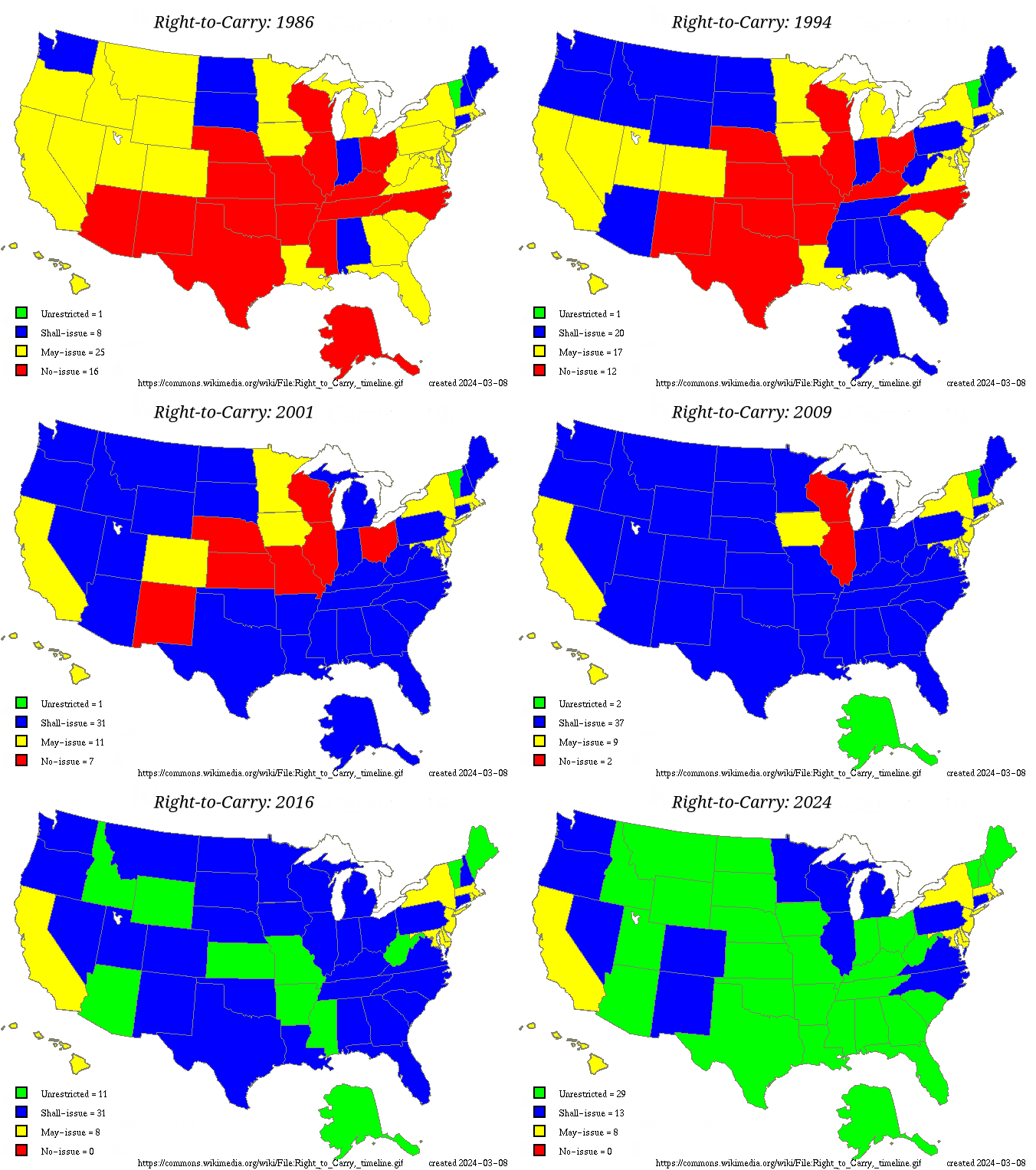
On Oct. 31, 2016, there were more than 95,000 active concealed pistol permits in South Dakota according to the secretary of state's office. The population of South Dakota in 2016 is 844,877. About 65.4% of the population is 18 or older. That would be 552,550. People with concealed carry permits are now 17% of the adult population. South Dakota's homicide rate in 2015 was 3.7 per 100,000, unusually high for South Dakota, but well below the national average of 4.9 per 100,000.
The difficulty in passing "Constitutional" carry in South Dakota is getting the bill past Governor Daugaard. Now that several other states have successfully passed permitless or "Constitutional" carry without ill effects, the bill may have a chance of becoming law.
©2016 by Dean Weingarten: Permission to share is granted when this notice is included.
Link to Gun Watch
Wednesday, November 23, 2016
FL: Clerk Shoots, Kills, Robber, Stops Crime Spree
A gas station clerk shot and killed a suspected serial robber during a Saturday evening holdup in south Tallahassee.
Matthew Brown, a 20-year-old connected to several recent Leon County robberies, was shot and killed at the Sunoco gas station at the corner of Woodville Highway and Gaile Avenue.
More Here
CA: More on Christiansen Shooting
After a two week long trial in Solano County Superior Court, a man facing a murder charge in a Vallejo woman’s death was found not guilty last Thursday by a jury and has now been released from custody after more than two years in county jail.
Michael David Wilson, 49, was accused in the shooting death of 57-year-old Lillie Mae Christiansen, who was shot and killed in July 2014 on the front porch of her friend’s apartment along Mare Island Way in Vallejo. Wilson’s attorney argued that her client acted in self defense and that proved to be enough to sway the jury in favor of the man’s innocence. Wilson was released from Solano County Jail on Thursday following his acquittal.
More Here
AL: Armed Man Shoots, Kills Home Invader at 3 a.m.
FLORENCE, AL (WAFF) -
A home invasion in Florence left the suspect dead early Tuesday.
Florence police say the homeowner shot and killed the suspect, identified as James Devaughn Demoss, 26, of Hanceville.
More Here
OH: Woman Shoots Intruder, Investigation Ongoing
The homeowner, Yalanda Whipple, told police she was in her bedroom when she heard her two children cry out with alarm.
Whipple says she grabbed a gun from under her pillow, and went to the kitchen where she was confronted by a man dressed in black. She then opened fire.
More Here
IN: Domestic Defense, Father Shoots Son to Protect Wife
Investigators say Matthew Uloth was attacking his mother when his father Jon Uloth shot him.
When Deputies arrived, they say Matthew punched a Deputy in the jaw.
Authorities do not expect to file charges against the father at this time.
More Here
Wisconsin CCW Permit Holders Made a Difference in The Trump Election

Wisconsin was one of the last states to create a permit system for legal concealed carry of weapons. Permits were first issued in November, 2011. Five years later, 319,069 Wisconsin residents had permits.
To obtain a permit, the applicant had to be 21 years old or older, a legal Wisconsin resident, and not convicted of any felonies or misdemeanor acts of domestic violence.
People who go to the trouble to obtain a permit are serious about their Second Amendment rights. In Wisconsin, probably half are Democrats and Independents. CCW permit holders are, as a group, some of the most law abiding people in America.
My experience as a concealed carry instructor showed me that these people are ultra responsible. They show up early. They offer to help out. They offer to clean up. I never had a problem with bad checks, in fifteen years.
My experience was that most are not NRA members. Most are not hunters. Most are gun owners. A significant number are veterans or have experience with law enforcement. They tend to be older, experienced, people. About 20 percent are women.
These people are voters, and they vote. I believe they vote in very large numbers, probably in excess of 80 percent.
The 2016 general election in Wisconsin was down a bit from 2012. There were 3.068 million votes cast for presidential candidates in 2012. The 2016 election had 2.944 million votes cast, down about four percent.
The difference between Donald Trump and Hillary Clinton in Wisconsin was 27,257 votes. That is less than 9% of the concealed carry permit holders in the state. In 2016, Donald Trump actively courted Second Amendment supporters. He actively courted concealed carry permit holders. He bragged about having a concealed carry permit. He promised that a priority of his administration would be to pass national concealed carry reciprocity, something desired by the vast majority of CCW permit holders.
In contrast, Hillary Clinton made "common sense" gun control a major plank in her platform. Her euphemism might have gotten a pass from a majority of people who do not own guns. It would not have gotten a pass with informed gun owners, which, includes, almost be definition, people who have a concealed carry permit.
Support for the Second Amendment was not a pivotal issue in the 2012 election. Most Second Amendment supporters were not enthusiastic about Mitt Romney. President Obama did not push for more gun control with any enthusiasm, until after the election.
Wisconsin only had one year of its shall issue concealed carry program in effect by election night, 2012. By election night 2016, it had over 319,000 concealed carry permit holders.
They made a difference. Was it enough to swing the election? It is impossible to know. But when Democrats explicitly endorse gun control, they lose, and they lose bigly (big league).
Donald Trump pulled off the biggest upset of presidential politics since Truman. Part of his campaign was to actively pursue Second Amendment supporters.
©2016 by Dean Weingarten: Permission to share is granted when this notice is included.
Link to Gun Watch
DoD Contingency for a President Trump: Directive 5210.56

The U.S. military makes contingency plans for a great many possibilities. It appears that the DoD has a contingency plan in place for a Trump presidency. Donald Trump has said he will eliminate gun free zones in the military and at recruitment centers on day one of his presidency.
On November 18th, the Department of Defense released DoD Directive 5201.56. Deputy Secretary of Defense, Robert O. Work, issued the directive on Arming and the Use of Force, that superficially does away with "Gun Free Zones". It allows commanders at the O-5 level and above to grant people the authority to carry private defensive weapons.
O-5 is a Lieutenant Colonel (LTC) for the Army, Air Force, and Marines; Commander (CDR) for the Navy and Coast Guard. Not all O-5 officers have the authority; only commanders of units, installations or other organizations do. A military commander is a specific position. Not all officers are commanders. An officer who takes a command position has many special responsibilities and privileges. They stay with the position when another officer takes his place.
The directive is highly restrictive, but it allows for authorizeed DoD personnel to carry personal, privately owned defensive weapons. From dtic.mil:
Each permit holder must be individually approved by the commander involved. That takes a lot of the commander's valuable time. There are plenty of reasons for commanders to turn down requests en masse, and no incentives given to commanders to approve requests.
The first restriction does much to gut any effective numbers of personnel carrying defensive weapons. It is unlikely that there will be many DoD personnel that will not routinely enter federal buildings. It requires that the Commander determine, after consultation with legal counsel, that an exception under 930(d) of Title 18, U.S.C. applies. From the directive:
Commanders are caught in a sort of legal bind here. They are being required to have legal counsel tell them that one of the three exceptions applies. But the directive itself could easily be interpreted to suffice for exceptions (2) and (3), especially if the person applying has a concealed carry permit.
Carrying a weapon for defense of self and others, and especially with a permit, is a lawful purpose in all U.S. territory. Carrying a weapon after being authorized to do so by a U.S. military commander, is also a lawful purpose.
The directive could have stated that the directive itself meets exceptions (2) and (3), thus taking the burden from individual commanders.
Some other restrictions:
The finding of lawful exceptions to 930(d) of Title 18, U.S.C. should be included in the directive, relieving individual commanders of that burden.
Commanders should be given incentives to authorize defensive carry. Such an incentive might be:
This directive was put into effect 10 days after the election of Donald Trump. That indicates the Department of Defense takes President elect Trump's (and future Commander in Chief) promises seriously. If you want a policy done on your terms, one of the most effective ways to obtain it is to present it as already accomplished.
President Trump will be well informed of such tactics. I expect he will make appropriate improvements.
©2016 by Dean Weingarten: Permission to share is granted when this notice and link are included.
Link to Gun Watch
On November 18th, the Department of Defense released DoD Directive 5201.56. Deputy Secretary of Defense, Robert O. Work, issued the directive on Arming and the Use of Force, that superficially does away with "Gun Free Zones". It allows commanders at the O-5 level and above to grant people the authority to carry private defensive weapons.
O-5 is a Lieutenant Colonel (LTC) for the Army, Air Force, and Marines; Commander (CDR) for the Navy and Coast Guard. Not all O-5 officers have the authority; only commanders of units, installations or other organizations do. A military commander is a specific position. Not all officers are commanders. An officer who takes a command position has many special responsibilities and privileges. They stay with the position when another officer takes his place.
The directive is highly restrictive, but it allows for authorizeed DoD personnel to carry personal, privately owned defensive weapons. From dtic.mil:
4.1. GENERAL.Here are some highlights of the directive. There are many restrictions. There are so many, the directive is almost, but not quite useless.
This section provides guidance for determining the eligibility of DoD personnel to carry privately owned firearms on DoD property for personal protection when it is not related to the performance of official duties. This section also provides requirements for individual training, transport, safeguarding, and storage of privately owned firearms that the arming authority must consider when determining whether to permit an individual to carry a privately owned firearm on DoD property.
Each permit holder must be individually approved by the commander involved. That takes a lot of the commander's valuable time. There are plenty of reasons for commanders to turn down requests en masse, and no incentives given to commanders to approve requests.
The first restriction does much to gut any effective numbers of personnel carrying defensive weapons. It is unlikely that there will be many DoD personnel that will not routinely enter federal buildings. It requires that the Commander determine, after consultation with legal counsel, that an exception under 930(d) of Title 18, U.S.C. applies. From the directive:
a. May grant permission to DoD personnel requesting to carry a privately owned firearm (concealed or open carry) on DoD property for a personal protection purpose not related to performance of an official duty or status. Permissions granted under this section do not apply to carrying a firearm within federal buildings unless the arming authority specifically determines, after consultation with servicing legal counsel and in accordance with applicable DoD policy, that an appropriate exception under Section 930(d) of Title 18, U.S.C. applies.Here is 930(d) of Title 18, U.S.C.:
(d) Subsection (a) shall not apply to—
(3) the lawful carrying of firearms or other dangerous weapons in a Federal facility incident to hunting or other lawful purposes.
Carrying a weapon for defense of self and others, and especially with a permit, is a lawful purpose in all U.S. territory. Carrying a weapon after being authorized to do so by a U.S. military commander, is also a lawful purpose.
The directive could have stated that the directive itself meets exceptions (2) and (3), thus taking the burden from individual commanders.
Some other restrictions:
- Personnel authorized must be 21 years of age or older
- Personnel not subject to *any* past or pending personnel action
- When permitted to carry concealed, the firearm must be completely concealed, and not interfere with normal duties
- May not carry while under the influence of alcohol or other intoxicants
The finding of lawful exceptions to 930(d) of Title 18, U.S.C. should be included in the directive, relieving individual commanders of that burden.
Commanders should be given incentives to authorize defensive carry. Such an incentive might be:
If an applicant who has a valid concealed carry permit is refused by the authorizing authority, a written explanation of the reason for refusal shall be given to the applicant. Applicants that are refused may appeal the refusal to the Inspector General of the organization.
This directive was put into effect 10 days after the election of Donald Trump. That indicates the Department of Defense takes President elect Trump's (and future Commander in Chief) promises seriously. If you want a policy done on your terms, one of the most effective ways to obtain it is to present it as already accomplished.
President Trump will be well informed of such tactics. I expect he will make appropriate improvements.
©2016 by Dean Weingarten: Permission to share is granted when this notice and link are included.
Link to Gun Watch
GA: Employee Uses Tactical Judgment, Shoots Armed Robber

Image from 11alive.com
On November 21, 2016, in Atlanta, Georgia, an armed robber attempted to victimize a Dollar store. Attempted is the operative word. The suspect did not succeed. He was wounded twice for his efforts, then he was arrested. He is lucky to have survived. From 11alive.com:
Atlanta Police say the man walked into the store around 9:55 p.m., pulled a gun and demanded the contents of the store’s cash register.It appears that the suspect never fired a shot. This was, in part, because of good tactical judgment on the part of the defender who shot him. A robber who displays a gun does not cease being a threat because he is walking away. A deadly shot can be fired in a fraction of a second.
As the robber was leaving the store with the cash register itself, an Atlanta Police spokesman said one of the store’s employees pulled a personal handgun and shot the suspect in the hand and thigh. Police then arrived on the scene and took the suspect into custody without any incident.
Defenders should be thinking about when to act in a defensive situation. In some situations, there are few choices. In others, the choices are abundant. If a criminal is attempting to gain compliance, the possibility of a an advantageous time or circumstance is high.
It is difficult for criminals to keep focused on all possible threats at all times. Their attention may be diverted by an opening door. They may allow an unarmed accomplice to intervene between them and their victim. Even a glance in another direction is enough to allow a practiced individual to draw and fire.
It is not uncommon for a suspect to focus their attention on their main object: the loot. Some have put down their guns to better grab the loot.
In the Dollar store in Atlanta, the defender waited until the suspects hands were full with the cash register. This did not stop the suspect from being a threat; but it made his response slow and ineffective.
Each situation will be different. Consider your options. If you decide to make a move, time it to your advantage. Thinking through possibilities before a situation occurs, playing what-if games, will give you a number of pre-considered options and make your response faster and more effective.
©2016 by Dean Weingarten: Permission to share is granted when this notice and link are included.
Link to Gun Watch
Subscribe to:
Posts (Atom)

 Posts
Posts


