Monday, March 09, 2020

Unregulated Gun Shows Save Lives (Peer Reviewed Study)


In a paper published in 2008, comparing highly regulated Californian gun shows with relatively unregulated Texas gun shows, there was no statistical difference in suicide rates, or in homicide rates in California. The Texas gun shows, with far less regulation, showed a statistically significant drop in the homicide rate. From the study, on page 4:
"But our results provide little evidence of a gun show-induced increase in mortality in Texas. In fact, we find that in the two weeks following a gun show, the average number of gun homicides declines in the area surrounding the gun show. Aggregating across all gun shows in the state, we find that there are approximately 16 fewer gun homicides resulting from the 200 gun shows in the average year. In the sections below, we discuss several possible explanations for this counter intuitive finding. However, it is important to keep in mind that while these results are statistically significant, they are quite small – representing just one percent of all homicides in Texas in the average year."
The authors downplay this result. It is not mentioned in the abstract. From the study:
 Abstract 

Thousands of gun shows take place in the U.S. each year. Gun control advocates argue that because sales at gun shows are much less regulated than other sales, such shows make it easier for potential criminals to obtain a gun. Similarly, one might be concerned that gun shows would exacerbate suicide rates by providing individuals considering suicide with a more lethal means of ending their lives. On the other hand, proponents argue that gun shows are innocuous since potential criminals can acquire guns quite easily through other black market sales or theft. In this paper, we use data from Gun and Knife Show Calendar combined with vital statistics data to examine the effect of gun shows. We find no evidence that gun shows lead to substantial increases in either gun homicides or suicides. In addition, tighter regulation of gun shows does not appear to reduce the number of firearms-related deaths.
This was not a small study. It included data for 10 years and 3,300 gun shows. The two states chosen, California and Texas, contain 20 percent of the population of the United States. It was not conducted by firearm freedom advocates or the NRA.

The authors suggest two untested hypothetical reasons for the measured decrease in homicide.

One, the possibility that police are somehow more vigilant after a gun show, and are preventing homicides... or

Two, that criminals are using unregulated gun shows to sell their guns, thus depriving themselves of weapons to commit homicide with...

Both of those hypothetical reasons fail to overcome Occam's razor. There are simpler, direct, obvious possibilities.

First, gun shows could make criminals more aware of the possibility of their victims being armed, thus causing them to delay their homicidal attempts.

When criminals notice that a gun show is being held in an area, and people can more easily buy and sell guns, it is reasonable to believe they would understand potential victims could be armed. This belief would result in less homicide attempts, and less homicides.

Second, victims may be more likely to arm themselves at a gun show, thus increasing the potential for homicidal criminals to be deterred by an armed victim.

The authors of the study chose to ignore these obvious, direct possibilities.

In the study, the authors tell us the statistically significant difference could reduce homicides in Texas by 1%. They minimize that effect. If a restriction on private ownership of guns was shown to reduce homicide by 1%, it would be shouted to the heavens.

The evidence is clear. Stopping private sales at guns shows costs lives.

It follows that so-called universal background checks may cost lives.

The demand that all private sales be approved of by state agents before they can be made, is counterproductive and will cost innocent lives.

If this seems counter intuitive, there is considerable evidence more guns result in less crime. The logic to support this is not unreasonable.

Criminals often make rational decisions based on their understanding of the environment that they are in. If criminals believe their intended victim may be armed, they often chose another target, decide not to commit the crime, or decide to commit a non-confrontational crime such as theft from an unoccupied vehicle.

The statistical significance in the study shows this is not a random artifact of the data gathering process.

©2020 by Dean Weingarten: Permission to share is granted when this notice and link are included.

Gun Watch

TX: Homeowner Shoots Suspect throught door, one shot to each leg


HOUSTON — A suspect attempting to break into a home in the Aldine area Sunday morning was shot by the homeowner.

According to the homeowner, the intruder climbed over his private fence and attempted to get inside of his home multiple times.

That's when the homeowner fired twice through the door, Harris County deputies said, hitting the suspect twice -- once in each leg.
More Here

CA: Resident Shoots, Wounds man Attempting to Break-in


“Officers responded to a report of a male suspect who had been shot by a resident while attempting to break into a residence,” police said in a written statement.

The suspect was found suffering from a single gunshot wound, officials said. He was taken to a hospital in unknown condition and was undergoing surgery Sunday afternoon.
More Here

OR: Landowner Defends Animals, Shoots Killer Mountain Lion


By March 1, the cougar returned and killed two more goats two houses from the first attack. The landowner, who was not identified, shot it the next day when it came back to feed on the carcasses.

"That's five visits in six days to that neighborhood," Thompson said. "It's kind of an anomalous situation to have one that comes back that often."

ODFW is experiencing a rash of cougar complaints in and around The Dalles, with as many as three or four calls per week, Thompson said. The reason is tough to pin down, though it could be due to a steep decline in the local deer population, which has been hit by outbreaks of adenovirus and epizootic hemorrhagic disease in recent years.
More Here

Followup IL: Wounded Man suspected of being in Gunfight with Off Duty Officer


CHICAGO (CBS) — A man turned up at a hospital miles away with a gunshot Sunday, following a shooting involving a gunman and an off-duty police officer in the Forest Glen neighborhood.

Police say an officer heading to work around 8:30 a.m. was in the 5200 block of North Lawler Avenue when he saw someone trying to steal a catalytic converter from a parked vehicle. He announced he was an officer and attempted to intervene when the suspect shot at him.

It was initially unclear whether the suspect was struck, but it turned out he was wounded in the hip.
More Here

Sunday, March 08, 2020

Senator Schumer Threatens Supreme Court Justices to do his Bidding


Link to twitter video

Democrat Minority leader in the Senate, publicly threatened justices of the Supreme Court today in front of the Supreme Court. The threats were recorded and published on Twitter.

The above tweet, with the recording, was published by Steve Scalise, Republican Whip in the House. Representatibve Scalise was nearly killed in an assassination attempt on Republican members of Congress by a Democrat follower of Bernie Sanders.

This is not the first time Democrat Senators have threatened the Supreme Court.  On August 12, 2019, less than seven months ago, five Democrat senators, Sheldon Whitehouse, Mazie Hirono, Richard Blumenthal, Richard Durbin, and Kirsten Gillibrand, submitted an amici curae brief to the Supreme Court on the New York State Rifle and Pistol Association v. NYC case. The brief was very close to a direct threat to the court. From the brief:
The Supreme Court is not well. And the people know it. Perhaps the Court can heal itself before the public demands it be “restructured in order to reduce the influence of politics.”Particularly on the urgent issue of gun control, a nation desperately needs it to heal.

The implication is obvious: Nice little Court you have there. Be a shame if something were to happen to it. Rule the way we want, and you may keep your Court.


Ever since the Franklin Delano Roosevelt administration, the court has become more and more politicized. The court has found rights no one ever knew existed, while studiously ignoring rights specifically protected in the Constitution, such as the Second Amendment. It has expanded federal power through the commerce clause to virtually every action in the United States, rendering the commerce clause meaningless.  A federal government limit to regulate interstate commerce is meaningless when all activity is defined as interstate commerce, or, even more encompassing, affecting interstate commerce, and therefore subject to federal regulation.  

Constitutionalists, believing in the necessity of the rule of law, have patiently worked to overcome the lobbying of Progressives, who do not believe themselves bound by the Constitution.  Over decades, in the face of direct, obvious political opposition to the Constitutional rule of law by leftists, Constitutionalists have finally been able to have a bare majority of originalist and textualist justices appointed to the Supreme Court. This is the first time an originalist and textualist majority has existed on the court for at least 80 years.

This has enraged Senator Schumer and like minded progressives, who apparently believe there should be no limits on government power, except what they create, based on their desire to remain in power.

Senatore Schumer believes the Constitution does not limit what infringements can be made on the right to keep and bear arms; he believes the federal government has the Constitutional power and authority to limit the laws the states may pass to regulate abortions.

Decades of judicial activism may be undone if the Constitution is faithfully interpreted and followed.

Second Amendment rights may finally be enforced by the Court.

Legal discrimination in favor of leftist groups could be ruled invalid under equal protection under the law.

States might be allowed to check voters for eligibility.

Illegal immigrants might be ruled as not entitled to more political favors than citizens.

Federal District courts might not be able to override presidential executive actions

All of which means less power for leftist politicians.

In Senator Schumer's mind, such a result seems to be completely unacceptable.

Chief Justice Roberts felt compelled to respond to such a direct threat.  From nationalreview.com:

“Justices know that criticism comes with the territory, but threatening statements of this sort from the highest levels of government are not only inappropriate, they are dangerous. All Members of the Court will continue to do their job, without fear or favor, from whatever quarter,” Roberts said.


©2020 by Dean Weingarten: Permission to share is granted when this notice and link are included.

Gun Watch


TX: Double Disarm, no one Shot in Burglary


The sheriff’s office said an 18-year-old woman was asleep, heard someone in the house and awoke her 19-year-old boyfriend, who confronted two men in black masks, one of whom had a rifle.

The office said the boyfriend was able to get the rifle away from the man and also pulled the man’s mask off, recognizing the man as an acquaintance. The other masked man fled.

The sheriff’s office said the 19-year-old eventually grabbed his own rifle and struggled with the now unmasked man, who took the 19-year-old’s rifle. During the struggle, both men went through a glass door and the suspect fled.

More Here

Followup WI: Todd Parker was Man Shot as he Attempted to break into Home


MAUSTON (WKOW) -- A man who allegedly tried to break into a town of Kingston home Wednesday before being shot by the owner has been identified by authorities.

Todd Parker, 21, Wisconsin Rapids, was shot several times with a handgun, according to the Juneau County Sheriff's Office. Responders airlifted Parker to the hospital.
More Here

Saturday, March 07, 2020

GA: Warning Shot Results in Return Fire

After he heard a noise at the back of this residence, the homeowner came outside to investigate armed with a shotgun. He encountered Carswell trying to break into the back of his home and fired a shot in the air. That’s when Carswell allegedly started to flee while firing at the homeowner, the release said.

Read more here: https://www.macon.com/news/local/community/houston-peach/article240953496.html#storylink=cpy

More Here

Followup KY: Convicted Felon Jackie Mutter found not guilty in Killing od Wendel Jackson


SCOTTSVILLE – Bolstered by claims that he acted in self-defense, Jackie Mutter was found not guilty Thursday of murder.


A jury of eight women and four men in Allen Circuit Court deliberated for 31/2 hours at the end of a four-day trial before acquitting Mutter, 65, of Scottsville, in the 2017 shooting of Wendell Jackson, 38, of Scottsville.
More Here

IL: Gunfight in Chicago, Off Duty Officer Fires Back

A man was shot, and an off-duty Chicago police officer who was with him returned fire Friday night in the Gage Park neighborhood on the Southwest Side.

More Here

Friday, March 06, 2020

Justice Gorsuch on the Bump Stock Ban Denial of Cert in GUEDES v. BATFE


In 2019, in response to a single criminal act, faced with intense media pressure, resulting in political pressure, the Bureau of Alcohol, Tobacco, Firearms, and Explosives, (BATFE) moved to ban bump stocks. They did so, claiming bump stocks were machine guns, contrary to numerous findings they had made over the last several decades.

The new regulation was challenged in the courts. The first case to be appealed to the Supreme Court was filed in the District of Columbia. On 2 March, 2020, the Supreme Court denied a writ of certiorari, the legal term to say they declined to hear the case. The Supreme Court declines to hear most cases. Very often, justices do not comment when writs of certiorari are denied.

The doctrine the United States Court of Appeals for the District of Columbia used to uphold the regulation is called the Chevron doctrine. It essentially says bureaucracies may interpret vague laws to make specific regulations. 

Justice Gorsuch, the first justice appointed by President Trump, felt compelled to write a brief statement explaining why the Supreme Court did not grant certiorari. Here is his statement in its entirety. From supremcourt.gov
Statement of JUSTICE GORSUCH.  

Does owning a bump stock expose a citizen to a decade in federal prison? For years, the government didn’t think so. But recently the Bureau of Alcohol, Tobacco, Firearms and Explosives changed its mind. Now, according to a new interpretive rule from the agency, owning a bump stock is forbidden by a longstanding federal statute that outlaws the“possession [of] a machinegun.” 26 U. S. C. §5685(b), 18 U. S. C. §924(a)(2). Whether bump stocks can be fairly re-classified and effectively outlawed as machineguns under existing statutory definitions, I do not know and could not say without briefing and argument. Nor do I question that Congress might seek to enact new legislation directly regulating the use and possession of bump stocks. But at least one thing should be clear: Contrary to the court of appeals’s decision in this case, Chevron U. S. A. Inc. v. Natural Re-sources Defense Council, Inc. 467 U. S. 837 (1984), has nothing to say about the proper interpretation of the law before us. 

 In the first place, the government expressly waived reliance on Chevron. The government told the court of appeals that, if the validity of its rule (re)interpreting the machinegun statute “turns on the applicability of Chevron, it would prefer that the [r]ule be set aside rather than up-held.” 920 F. 3d 1, 21 (CADC 2019) (Henderson, J., concur-ring in part and dissenting in part) (noting concession). Yet, despite this concession, the court proceeded to uphold the agency’s new rule only on the strength of Chevron deference. Think about it this way. The executive branch and affected citizens asked the court to do what courts usually do in statutory interpretation disputes: supply its best in-dependent judgment about what the law means. But, in-stead of deciding the case the old-fashioned way, the court placed an uninvited thumb on the scale in favor of the government. 

That was mistaken. This Court has often declined to apply Chevron deference when the government fails to invoke it. See Eskridge & Baer, The Continuum of Deference: Supreme Court Treatment of Agency Statutory Interpretations From Chevron to Hamdan, 96 Geo. L. J. 1083, 1121– 1124 (2008) (collecting cases); Merrill, Judicial Deference to Executive Precedent, 101 Yale L. J. 969, 982–984 (1992) (same); see BNSF R. Co. v. Loos, 586 U. S. ___ (2019). Even when Chevron deference is sought, this Court has found it inappropriate where “the Executive seems of two minds” about the result it prefers. Epic Systems Corp. v. Lewis, 584 U. S. ___, ___ (2018) (slip op., at 20). Nor is it a surprise that the government can lose the benefit of Chevron in situations like these and ours. If the justification for Chevron is that “‘policy choices’ should be left to executive branch officials ‘directly accountable to the people,’Epic Systems, 584 U. S., at ___ (slip op., at 20) (quoting Chevron, 467 U. S., at 865), then courts must equally respect the Executive’s decision not to make policy choices in the interpretation of Congress’s handiwork. 

To make matters worse, the law before us carries the possibility of criminal sanctions. And, as the government itself may have recognized in offering its disclaimer, whatever else one thinks about Chevron, it has no role to play when liberty is at stake. Under our Constitution, “[o]nly the people’s elected representatives in the legislature are authorized to ‘make an act a crime.’United States v. Davis, 588 U. S. ___, ___ (2019) (slip op., at 5) (quoting United States v. Hudson, 7 Cranch 32, 34 (1812)). Before courts may send people to prison, we owe them an independent determination that the law actually forbids their conduct. A “reason-able” prosecutor’s say-so is cold comfort in comparison.That’s why this Court has “never held that the Government’s reading of a criminal statute is entitled to any deference.” United States v. Apel, 571 U. S. 359, 369 (2014). Instead, we have emphasized, courts bear an “obligation” to determine independently what the law allows and forbids. Abramski v. United States, 573 U. S. 169, 191 (2014); see also 920 F. 3d, at 39–40 (opinion of Henderson, J.); Esquivel-Quintana v. Lynch, 810 F. 3d 1019, 1027–1032 (CA6 2016) (Sutton, J., concurring in part and dissenting in part). That obligation went unfulfilled here. 

Chevron’s application in this case may be doubtful for other reasons too. The agency used to tell everyone that bump stocks don’t qualify as “machineguns.” Now it says the opposite. The law hasn’t changed, only an agency’s interpretation of it. And these days it sometimes seems agencies change their statutory interpretations almost as often as elections change administrations. How, in all this, can ordinary citizens be expected to keep up—required not only to conform their conduct to the fairest reading of the law they might expect from a neutral judge, but forced to guess whether the statute will be declared ambiguous; to guess again whether the agency’s initial interpretation of the law will be declared “reasonable”; and to guess again whether a later and opposing agency interpretation will also be held “reasonable”? And why should courts, charged with the independent and neutral interpretation of the laws Congress has enacted, defer to such bureaucratic pirouetting? 

Despite these concerns, I agree with my colleagues that the interlocutory petition before us does not merit review.The errors apparent in this preliminary ruling might yet be corrected before final judgment. Further, other courts of appeals are actively considering challenges to the same regulation. Before deciding whether to weigh in, we would benefit from hearing their considered judgments—provided, of course, that they are not afflicted with the same problems. But waiting should not be mistaken for lack of concern.

Waiting should not be mistaken for lack of concern.

Waiting should not be mistaken for lack of concern. That seems to be the main thrust of Justice Gorsuch's message. In the last paragraph, he agrees with his colleagues that this stage of the proceedings is not the appropriate time for them to take the case. His indication that other courts are considering the same question indicates the issue is far from decided.

It is interesting the executive branch did not claim the Chevron doctrine to justify the bump stock ban, and the DC appeals court insisted on applying it to the case. Did the U.S. executive branch set the case up to fail?

Second Amendment supporters have been waiting for the courts to uphold Second Amendment rights for decades. They were happy to see some movement with the Heller decision, and then, in 2010, the McDonald decision. A decade passed with the Second Amendment being relegated to second class status by numerous appeals courts.

Justice Gorsuch's message indicates he understands some of the frustration many Second Amendment supporters feel about the lack of the Supreme Court's willingness to uphold the rule of law.

It is a positive sign.


©2020 by Dean Weingarten: Permission to share is granted when this notice and link are included.

Gun Watch


OH: Man with CCW Stops Theft of his Motorcycle

Police responded to a disturbance in the parking lot of a West Market Street store March 1 after a man reported a group of males approached him, demanded his motorcycle and threatened him. The victim, who has a permit to carry a gun, put his hand on the weapon, took out his cellphone and told them he was calling the police and they fled. Police located the males, and the victim identified them. An adult man and three juveniles were charged with disorderly conduct. The juveniles were released to their parents.

More Here

Thursday, March 05, 2020

Constitutional Carry in 2020 Tennesse and Louisiana at Bat


Constitutional Carry continues to gain members. One to three states are likely in 2020.

Constitutional Carry is the return to a close approximation of the state of law in the United States when the Bill of Rights was ratified in 1791.  At that time there were no permits required to carry weapons in public places, either openly or concealed.

Concealed weapons were common and popular. Examples are knives, sword canes, and Queen Anne's  or "muff" pistols.

This state of law persisted in the United States for 30 years, until nearly all the founding fathers were dead. 

The most likely state to pass a bill restoring Constitutional Carry in 2020 is Tennessee. Governor Bill Lee has publicly supported passing Constitutional Carry, as have the majority leaders in both the Senate and the House. A formal bill has yet to be submitted in the legislature.

Tennessee Firearms Association (TFA) has received a copy of an amendment said to be the heart of the proposed legislation.

The proposed legislation primarily creates an exception to existing law for either carrying a handgun, either openly or concealed. From TFA:
Section 1 of the proposed law does not alter TCA 39-17-1307(a) by “removing the Class C misdemeanor” – it is still there. What this bill does is it creates a new subpart (g) that says this:

It is an exception to the application of subsection (a) that a person is carrying, whether openly or concealed, a handgun and:
(1) The person meets the qualifications for the issuance of an enhanced handgun carry permit under § 39-17-1351(b) and (c);
(2) The person lawfully possesses the handgun; and
(3) The person is in a place where the person has a right to be.


The amendment creates an exception to a charge of illegal carrying if certain conditions are met.
There are several other limitations, but, generally, if a person can legally obtain a Tennessee concealed carry permit, under the new law they will be able to carry a handgun openly or concealed, without a permit.

Louisiana recently had a Constitutional Carry bill introduced in the legislature, as HB72. HB72 is similar to the Tennessee proposal, in that it creates an exception to existing law. If a person is not prohibited from possessing the firearm, and it was not illegally obtained or manufactured by the person who is carrying it; no permit would be required to carry. From HB72:

95. Illegal carrying of weapons


L. The provisions of Paragraph (A)(1) of this Section shall not apply to a person if all of the following conditions are met:

(1) The person is not prohibited from possessing the firearm under R.S.1614:95.1 or any other state or federal law. 

 (2) The firearm was not illegally manufactured or obtained by the person.
The Louisiana bill differs from Tennessee in that it strikes from the law the requirement to obtain a permit in order to carry a concealed handgun.

The Tennessee proposal has a peculiarity found in the Constitutional Carry states of Idaho, Wyoming, and North Dakota: It restricts Constitutional Carry to state residents.

This portion of the law might be struck down if a court challenge is mounted. There is strong precedent that a state may not discriminate against non-residents in such a broad based law, under the equal protection clause of the Fourteenth Amendment, especially when dealing with a fundamental right.

Cases are unlikely because Idaho recognizes all other state's permits, North Dakota recognizes 39 state permits, and Wyoming recognizes 34 state permits.

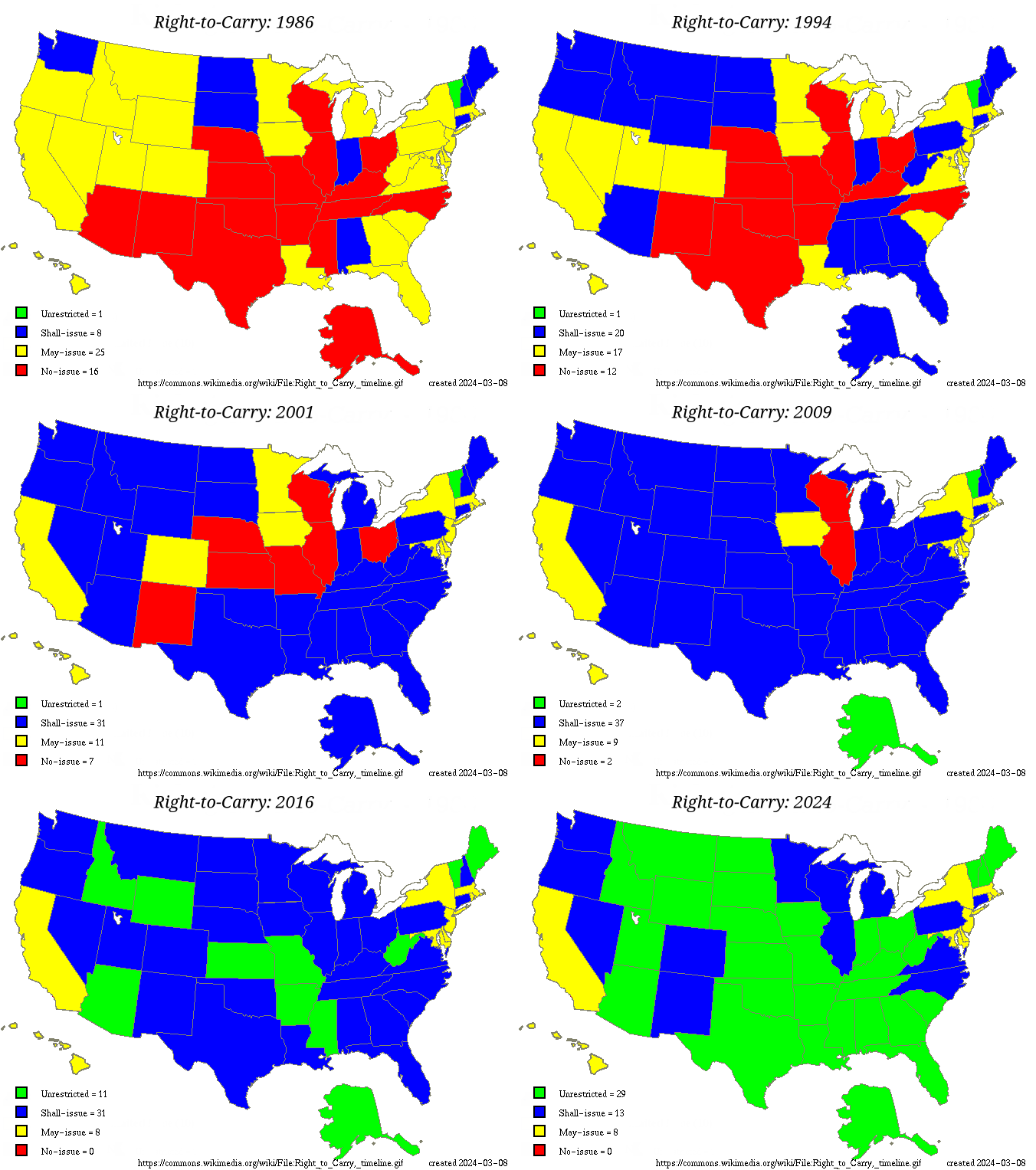
Depending on who makes the count, and how Constitutional Carry is defined, there are 16 states that have restored Second Amendment rights to an approximation of what they were when the Second Amendment was ratified in 1791.

No state which has restored Constitutional Carry has seen an increase in violent gun crime or in fatal gun accidents related to Constitutional Carry.

To restrict a Constitutionally protected right, the State should have to show a law is narrowly tailored to achieve a compelling government interest. If Constitutional Carry does not increase violent gun crime or fatal gun accidents, there is no compelling government interest.

Vermont has always had Constitutional Carry since 1791.

 In 2003, Alaska passed Constitutional Carry to restore the exercise of Second Amendment rights.

In 2010, Arizona passed Constitutional Carry.

In 2011, Wyoming passed Constitutional Carry.

In 2013, Arkansas passed Act 746 into law. It is effectively Constitutional Carry. Some county prosecutors threaten prosecution, but it has not happened.

In 2015, Kansas, and Maine became Constitutional Carry club members.

In 2016, Idaho, Missouri, West Virginia, and Mississippi became Constitutional Carry states.

In 2017, New Hampshire, and North Dakota passed Constitutional Carry.

In 2019, South Dakota, Oklahoma, and Kentucky passed Constitutional Carry.

Alabama, Indiana, Iowa, Texas, Georgia, South Carolina, Ohio, Utah, Wisconsin, and Michigan have had some movement on Constitutional Carry bills. Republican Governor Herbert of Utah vetoed a weak Constitutional Carry bill. Montana's Democrat Governor Bullock vetoed a Constitutional Carry bill twice.

Most bills will die in the legislative process, but one to three more states are likely to  restore Constitutional Carry in 2020.

©2020 by Dean Weingarten: Permission to share is granted when this notice and link are included.


NC: Armed Homeowner, Donald Bautista, Shoots, Kills Attacker

Bautista said he saw someone run into the wood-line behind his home moments before he was attacked by a suspect holding a wooden deck railing. Bautista sustained several defensive wounds before he fired one shot, killing the suspect later identified as Robert Burns.

More Here

WI: Armed Homeowner Shoots Man Attempting Break-In


KINGSTON TOWNSHIP, Wis. (WKBT) – A man attempting to break into a home in Kingston Township was shot by the homeowner early Wednesday morning in Juneau County.
More Here

AZ: Gunfight during Home Invasion, Resident and two Suspects all Wounded


Phoenix police say they were called to a home near 31st Avenue and Buckeye Road around 11 p.m. Tuesday for a shooting call.

Initial information suggests two men forced entry into a home and shot the man inside the home. The victim reportedly fired back at the suspects, hitting both of them.
More Here

IN: Resident Shoots 1 of 3 Assailants


ISP said 34-year-old Marcus Donald and two other men showed up at the home and got into a fight with a man who lived there. During the fight, the resident fired a handgun at the three men, who then fled the scene.

One of the three men had been shot in the abdomen. He was found later in the morning and taken to a Cincinnati-area hospital to be treated for serious injuries. Donald was later found in the area and arrested and charged with conspiracy to commit robbery. The third man has still not been found.

More Here

Wednesday, March 04, 2020

Progressive's Use of Hypotheticals Illustrated by LA Times Article


Many of the proposals of those who want a disarmed society are founded in wishful thinking. Hypothetical examples, based on false assumptions about the nature of reality, are put forward as if they are fact. One of the most blatant and one-sided examples of this was recently published in the Los Angeles Times.

The title of the piece is How many mass shootings might have been prevented by stronger gun laws?, by Rahul Mukherjee, on 26 February, 2020.

The article lists five types of restrictive gun laws and considers how they might have stopped 167 mass killings over the last 64 years.

The author appears to violate the rules of his own game.

Here are the five types of restrictions on gun ownership the author considered:

1. A ban on straw purchases. The author lists five cases where people made straw purchases for someone else. The other person then committed a mass murder. But straw purchases were illegal for all of the period where the five examples occurred.

The one example given, that of the Columbine High School killers, resulted in prison sentences for the two people who committed straw purchases for the Columbine killers.

It is hard to imagine the crimes would have been prevented, when the law was already in effect, and the crimes were *not* prevented.

2. Safe Storage Requirement, where guns would be required to be kept locked up when not in use.

The example given was of a 20 year old adult security guard, who was blocked from purchasing a semiautomatic weapon, then committed mass murder with his fathers firearms. It seems unlikely a lock on a box would have been sufficient to keep him from taking his father's firearms. There are several cases where people who committed mass murder stole the firearms they used. The  LA time article refers to the 20 year old adult security guard as an "underage shooter".


3. Assault weapons ban.

The article claims 38 mass murder events could have been prevented, including 6 which occurred during the federal "assault weapons" ban. It uses as the example, the rifle used in the Sandy Hook mass murder. But there already was an existing Connecticut assault weapons ban, passed in 1993, expanded in 2001.  Most of the mass murders in the database, 129 of 167, according to author Mukherjee, would not have been affected. There is little reason to suppose a substitution of weapons would not have occurred in the other 38. In the Sandy Hook case, the murderer, after murdering his mother, had access to numerous other weapons as well as the rifle he used.

4. Mandatory background checks (presumably a ban on private sales).

In yet another case of existing law failure, the author uses as an example the Charleston church murders from 2015. A background check was performed on the murderer, but the information that he was prohibited had not been reported to the FBI.

5. Red flag law

The author claims 141 of the 167 cases could have been prevented if Red Flag laws were in place. Then he gives another example of where existing laws were ignored.  He uses the Stoneman Douglas school mass murder.

There were numerous times where interventions could have occurred to prevent those murders, without "Red Flag Laws".  

The author does not explore how many failures of existing law occurred in the other cases. 

Hypothetical examples, or fantasies, such as pushed in the article are not useful in formulating policy. They are not based on fact, but on wishful thinking.

If we are to deal in hypothetical potentials, we may as well consider what would have happened if the victims in those mass killings had been armed. They events would almost certainly not have been mass killings. Most mass killings occur in places where the victims are not allowed to be armed.  Every one of the five mass killings highlighted as examples in the LA times article occurred where none of the victims were armed.

Armed victims or armed Samaritans have stopped mass murder in numerous cases, at least two dozen. 

The officers who shot back at Columbine were not killed.

In the Stoneman Douglas mass murders, the armed police officer ran outside the building and did not attempt to intervene, leaving the victims defenseless. He survived and is facing charges.

Most people who push for restrictions on firearms have the fantasy of a future without firearms.

Just consider the hypothetical "if there were no guns".

It is a fantasy. Homemade guns are made on every continent except, possibly, Antarctica.  Mass murders were committed long before guns were invented.

Without guns, the weak are subservient to the strong.

The author ignores the Second Amendment and Constitutional problems with their hypothetical fantasies.

A comparable hypothetical would be a law to forbid media from excessive reporting of mass murders, which is widely believed to trigger more mass murders with media contagion.

The United States has become the most powerful and most prosperous nation on earth, in large part because government power is limited.

Destroying the limits on government power will create far more problems than it will solve.

©2020 by Dean Weingarten: Permission to share is granted when this notice and link are included.

Gun Watch


CO: Man Fleeing Police Attempts to Carjack Off-Duty Deputy

PUEBLO, Colo (KKTV) - A man is dead after first leading police on a chase and then trying to carjack an off-duty Pueblo County sheriff's deputy late Sunday night.

More Here

WA: Armed Samaritan Stops Attack on Woman


Another man saw the attack from a nearby apartment, called 911, grabbed a gun and ran to help.

He yelled for the suspect to let go of the woman, and the attacker did so when he saw the gun.

Read more here: https://www.thenewstribune.com/news/local/crime/article240815906.html#storylink=cpy

More Here

TX: Gunfight in Game Room, 4-5 Masked Men, two Clerks Wounded


It happened in the 2900 block of Almeda Genoa Sunday night. Four to five masked men stormed the business with weapons, police said.

Gunfire broke out between the men and two game room employees. One employee was shot in the chest and the other was shot in the arm.


More Here

NC: Gunfignt, Customer Shoots, Kills Armed Robber in Store


"He grabbed her by the neck, brought her back [behind the counter] at gunpoint," Khawaja said.

The situation took an unexpected turn when one of the customers took advantage of the distraction, pulling out their own gun and firing shots at the suspect.

"[The customer] shot him four or five times," said Khawaja. "It happened like in 45 seconds. Like 30 to 45 seconds."
More Here

Tuesday, March 03, 2020

Iowa Range Protection and Strengthened Preempiton Bill Passes House


Iowa Radio is reporting that the Iowa range protection and strengthened preemption bill has passed the Iowa House. The bill passed on a 52 to 44 vote, with 4 members not voting. There are 56 Republicans and 44 Democrats in the Iowa House. The bill was earlier reported on as HSB 615.

Second Amendment supporters have been attempting to pass the bill for several years. HB2502:

From radioiowa.com:
Supporters of the bill say Iowa gun owners should not have to navigate a labyrinth of different ordinances. The bill also forbids cities and counties from trying to ban gun modifications or from establishing restrictive zoning aimed at gun shooting ranges.

The House passed the bill on a 52 to 44 vote as dozens of gun rights activists sat in the gallery watching the debate.
In addition to preventing local governments form passing prohibitive zoning ordinances to stop shooting ranges, the bill makes it illegal for local governments to regulate firearms accessories as well as firearms. This was likely inspired by the City of Des Moines and Polk County officials attempts to ban magazines and bump stocks in 2020. From HB2502:
2. A political subdivision of the state shall not enact an ordinance regulating the ownership, possession, legal transfer, lawful transportation, modification, registration, or licensing of firearms, firearms attachments, or other weapons when the ownership, possession, transfer, or transportation, or modification is otherwise lawful under the laws of this state. An ordinance regulating firearms, firearms attachments, or other weapons in violation of this section existing on or after April 5, 1990, is void.
 The bill prevents local governments from banning weapons in government buildings unless the building is secured with metal detectors and armed security in the building. Mere signage, without detectors or armed security is not considered adequate.

Gun Watch
NEW SUBSECTION . 4. A political subdivision of the state may restrict the carrying, possession, or transportation of firearms or other dangerous weapons in the buildings or physical structures located on property under the political subdivision’s control if adequate arrangements are made by the political subdivision to screen persons for firearms or other dangerous weapons and the political subdivision provides armed security personnel inside the building or physical structure where the restriction is to be in effect.
The logic of this part of the bill is clear. If a person is willing to obey a sign prohibiting weapons, they are unlikely to be a threat.

The bill also prevents the state courts from banning firearms in buildings other than in courtrooms or court office, or court house used only for judicial purposes. This section was prompted a ban on guns by Chief Justice Mark Cady in June of 2017.

 Iowa is one of the states with a trifecta of Republicans. As mentioned, there are 56 Republicans in the House, and 44 Democrats. Republicans have a majority of 32 Senators of 50 members of the Iowa Senate. The Governor is Republican Kim Reynolds, the first female governor of Iowa.

The Iowa legislature's first day of the 2020 session was on 13 January. The session is expected to end on 21 April, 2020.


 ©2019 by Dean Weingarten: Permission to share is granted when this notice and link are included.

More FL: When Ocosio Nettles Broke into his Ex's Apartment, he was shot

Shortly before 6 a.m., police said, Ocossio Nettles, 26, broke into his girlfriend’s apartment at 5877 Fairfield Ave. S in St. Petersburg and was confronted by 48-year-old Roderick Donson. Shots were fired and Nettles died at the scene, according to police.

More Here

FL: Gunfight at Off-Duty Officer's Home


Officers said the man was asked to leave the party. They said he returned at about 1:30 a.m. and tried to kick in Ortiz’s front door.

Ortiz told police the man shot at him when he went outside. Officers said Ortiz fired back, shooting the man multiple times.
More Here

GA: Armed Homeowner Shoots, Kills Home Invader


During the confrontation, police say the homeowner fired a handgun multiple times, hitting the intruder in the torso.

Medics treated the suspect, identified as 23-year-old Corey Patton II from Charlotte, North Carolina, at the scene before he was transported to a nearby hospital. Patton was pronounced dead at the hospital.
More Here

GA: Gunfight, Security Guard Wounded


The guard told officers he had seen an unknown suspect breaking into a customer's vehicle. When he confronted the suspect, he said the man began shooting while he fled.

Police say the security guard returned fire but was hit in the leg.
More Here

Monday, March 02, 2020

Tennesse Governor Lee Promotes Constitutioinal Carry Bill in 2020


On 27 February, 2020, at 1 p.m., Governor Bill Lee announced he is proposing Constitutional Carry for Tennessee in 2020. Tennessee has been a prime candidate to join the growing number of states with Constitutional Carry.

 Currently 16 states have Constitutional Carry of varying degrees. Constitutional Carry is an approximation of the state of law and the Second Amendment at the time of the ratification of the Bill of Rights in 1791. At that time there were no laws restricting the carry of weapons, openly or concealed. 

Concealed weapons were common in the early republic, from knives and sword canes to Queen Anne's or "Muff" pistols. From tn.gov:
NASHVILLE, Tenn. – Today, Gov. Bill Lee announced that he is proposing legislation to advance the Second Amendment rights of law-abiding Tennesseans by implementing a Constitutional Carry law.

“The Second Amendment is clear and concise and secures the freedoms of law-abiding citizens to keep and bear arms,” said Gov. Bill Lee. “I am pleased to announce Constitutional Carry legislation today that will protect the Second Amendment rights of Tennesseans, while also stiffening penalties on criminals who steal or illegally possess firearms. I appreciate Lt. Governor McNally and Speaker Sexton for helping to lead the way on this important issue.”

The governor’s legislation would extend the constitutional right to carry a handgun to all law-abiding citizens with or without a permit who are 21 and older, except in current restricted areas.

The legislation also includes several increased penalties for firearm-related crime to promote public safety including:
Increasing the penalty for theft of a firearm to a felony;
Providing a sentencing enhancement for theft of a firearm in a car;
Increasing the minimum sentence for theft of a firearm from 30 days to 180 days; Increasing the sentences for unlawful possession of a firearm by violent felons and felony drug offenders, possession of a handgun by a felon, and unlawfully providing a handgun to a juvenile or allowing a juvenile to possess a handgun.

“A big part of protecting the Second Amendment for law-abiding citizens is cracking down on criminals who use guns. We will make sure those who commit crimes with firearms serve their full sentences and nothing less. Many states across the nation are moving towards permitless carry and I support the governor in this initiative,” said Lt. Governor Randy McNally.

“This legislation ensures that law-abiding citizens have a constitutional right to carry their handgun, but if you are a violent criminal, felon or drug dealer, there will be no tolerance for unlawful gun possession here in Tennessee,” said Speaker Cameron Sexton.

“I applaud Governor Lee’s commitment to Tennesseans’ Second Amendment rights guaranteed by our U.S. and state constitutions. This proposal will reduce barriers to ensure citizens have the ability to protect themselves and their families, while imposing stiffer penalties against criminals who possess guns illegally,” said Senate Majority Leader Jack Johnson.

"This constitutional carry package is historic because not only does it uphold the freedoms granted to us by our nation’s founding fathers, it also imposes mandatory minimum sentencing guidelines on bad guys who illegally obtain or use handguns,” said House Majority Leader William Lamberth. “I want to thank the National Rifle Association for their work over the years in making today a reality, and I look forward to working with Governor Lee, as well as my House and Senate colleagues to get Constitutional Carry passed in Tennessee."
In 2019, in an Ammoland article, John Harris of The Tennessee Firearms Association was skeptical of the prospects for Constitutional Carry under a Governor Lee administration.

The potential for passage looks very good with Governor Lee and both the Senate Majority leader and the House Majority leader on board. The bill number and text have not been posted. As with all legislation, details are very important.

As of 2020, Ballotpedia reports there are 28 Republicans and 5 Democrats in the Tennessee Senate. There are 73 Republicans and 26 Democrats in the House, for super-majorities of Republicans in the entire legislature. The Tennessee legislature remains in session from 14 January, to 1 May in 2020. The bill should be introduced and acted on relatively quickly, if it is to pass in 2020.

If Tennessee becomes the first state to move into the Constitutional Carry camp in 2020, it will be the 17th state with Constitutional Carry. Over one third of all 50 states will then have a form of Constitutional carry, where no government permit is required for the open or concealed carry of a loaded handgun in most public places.

  ©2020 by Dean Weingarten: Permission to share is granted when this notice and link are included.

Gun Watch


NY: Gunfight, Home Invasion Homeowner Wounded 1 of 4 Suspects Shot, Killed

The Sheriff's Office dispatch received a call at 4:48 a.m. of shots fired in the area of Mount Hope Road in the Town of Lewiston. The Sheriff's Office said three armed suspects entered the house, exchanged shots with the homeowner and fled the scene.

More Here

Nebraska: Infringements on Right to Arms Defeated for 2020


On 21 February, 2020, hundreds of Second Amendment supporters showed up at the Nebraska legislature to exercise their First and Second Amendment rights. They were there to stop proposed infringements on the right to keep and bear arms. They were successful. 

Governor Pete Ricketts tweeted in support of the Second Amendment defenders.  

In Nebraska, bills are sent to a priority list by individual senator s or by being voted on in committee. Because the time the legislature is in session is limited, if a bill does not make it to the list, it is virtually killed off for the year. You can check the finalized priority list for the Nebraska legislature here.

LB58 and LB816 did not make it to the list. 21 February was the last day to make it to the priority list for 2020.

This year, the threats to the right to keep and bear arms were defeated. They will be back. In summation, here are the two bills and their titles in the Nebraska legislature. LB 58 red flag law:
LB58 - Adopt the Extreme Risk Protection Order Act
Berry Law is a Nebraska law firm. They have written analysis of LB58. From jsberrylaw.com:
The fundamental flaw in LB 58 is that it provides no due process for an individual to prevent the seizure of their firearms until it is too late. No other fundamental right is treated so cavalierly. After all, we don’t allow the government to raise our property tax assessments without notice and the right to a hearing before the assessment. We don’t trust the government to take away drivers’ licenses from those accused of drunk driving without providing notice and a hearing before the license is temporarily revoked. If we protect ourselves from taxation (not a fundamental right) and driving (also not a fundamental right) with notice and a fair hearing, it is extremely dangerous to start granting government the right to confiscate our legally obtained property without prior notice and a hearing.
LB 816 was the more prominent bill and received more media attention. In the legacy media, LB816 was referred to as a suicide prevention bill. LB 816 would require a permit to purchase most semi-automatic rifles and shotguns. From the Nebraska legislature,  LB 816:
LB816 - Provide for information and training on firearm safety and suicide prevention and place restrictions and requirements on certain transfers of firearms

Berry Law gives an explanation of how LB816 would work. Purchasers of most semi-automatic rifles and shotguns would have to meet the same requirements as for obtaining a concealed carry weapons (CCW) permit.  From jsberrylaw.com:
This new standard for being able to purchase handguns and “designated firearms” is significant because there are a series of minor legal violations that would prohibit a person from the privilege of obtaining a CCW permit, but not prevent people from otherwise owning or enjoying firearms. Additionally, no one under the age of 21 may have a CCW (or purchase a handgun) but the lawful age for ownership of rifles and shotguns is 18. Thus, LB 816 would prohibit the purchase or transfer of said firearms to anyone who isn’t 21 years of age.

Also of significance is that the bill defines “designated firearms” to include parts and accessories that do not meet any definition of a firearm. LB 816 seems to require a permit to purchase parts such as a flash hider, magazine, a folding stock or any countless numbers of accessories that will need a certificate to purchase. The Act requires the State Patrol to provide a list of all firearms and parts that meet the definition and publish the list annually (although exclusion from the list does not render the firearm or part exempt from the law).
The Nebraska bills were stopped because Second Amendment supporters showed up and used their First Amendment and Second Amendment rights.

(LB 958 was the third bill mentioned below. It was less of a threat than the other two bills.)

From omaha.com:
What was clear after Friday’s public hearings is that nothing will be done this year on gun control legislation. In the end, none of the three bills was prioritized by Friday’s deadline, meaning they won’t advance this year.

Brett Hendrix, a 28-year-old former Marine from Omaha, came to the hearings — and later testified — holding a black AR-15 rifle, and wearing a camouflage helmet and flak jacket.

“I’m here because no rights in the Second Amendment need to be abridged,” Hendrix said.

But gun control advocates said something needs to be done to keep guns away from people contemplating suicide or harm to others.

Consider the inherent bias of the sentence:
What was clear after Friday’s public hearings is that nothing will be done this year on gun control legislation.
A sentence, just as factual, but from a conservative perspective would be:
What was clear after Friday’s public hearings is that nothing will be done this year to infringe on Nebraskan's constitutional rights.
Notice the focus of the last paragraph mentioned:
"something needs to be done to keep guns away from people contemplating suicide or harm to others."
Many things are already being done. Family members often disable firearms or temporarily store them away from relatives who are contemplating suicide. There are several voluntary ways to accomplish this. There are already mechanisms for dealing with people who are contemplating harm to others.

There is a tremendous difference between doing something, and demanding the government do something by force.

If a person believes the government is always beneficent, and guns are always bad, giving the government the power to take guns from people without due process is an easy decision.

It is easy to give up someone else's rights and property.

©2020 by Dean Weingarten: Permission to share is granted when this notice and link are included.

Gun Watch


Sunday, March 01, 2020

FL: Domestic Defense? Man Breaks in Ex Girl friends House, is Shot, Killed


ST. PETERSBURG, Fla. — A man was shot and killed after breaking into his girlfriend's apartment, police say.

It happened at about 6 a.m. Saturday in the area of Fairfield Avenue and 59th Street S, according to the St. Petersburg Police Department.

Police say a 26-year-old man got into his girlfriend's apartment when he was confronted by a 48-year-old man. At some point, shots were fired and the 26-year-old died at the scene.

More Here

Followup IL: Armed Homeowner who Shot, Killed, Attacker, is Public Defender


UPDATE 4:45 p.m. - The Tazewell County State's Attorney, Stu Umholtz, confirmed that the man who fired the fatal shots in this case, is also the Tazewell County Public Defender.

According to police, Luke Taylor, shot at 41-year-old Daniel L. Williamson after he charged at Taylor and bit his face and head. Police said the shots were fired in self-defense.
More Here

TX: Masked Home Invasion Suspect Shot, Wounded


KATY, Texas — A home invasion suspect was shot Friday morning in Katy, a sergeant with the Harris County Sheriff’s Office confirmed.

More Here

AL: Car Burglary Suspect Shot, Wounded


The sheriff's office said several residents in the area reported the man prowling near multiple homes January 31. When responding to the call, deputies said the suspicious man was recognized by a homeowner as Jimmie Sanders and was shot in the leg. Sanders had apparently been in the area recently.
More Here